Reason #4 You Don't Want to Be an Affordable Housing Developer: The Government | Alan Biller
Why Government Makes Affordable Housing So Hard to Build
Reason #4: Government | With Alan Biller and Kent Fai He
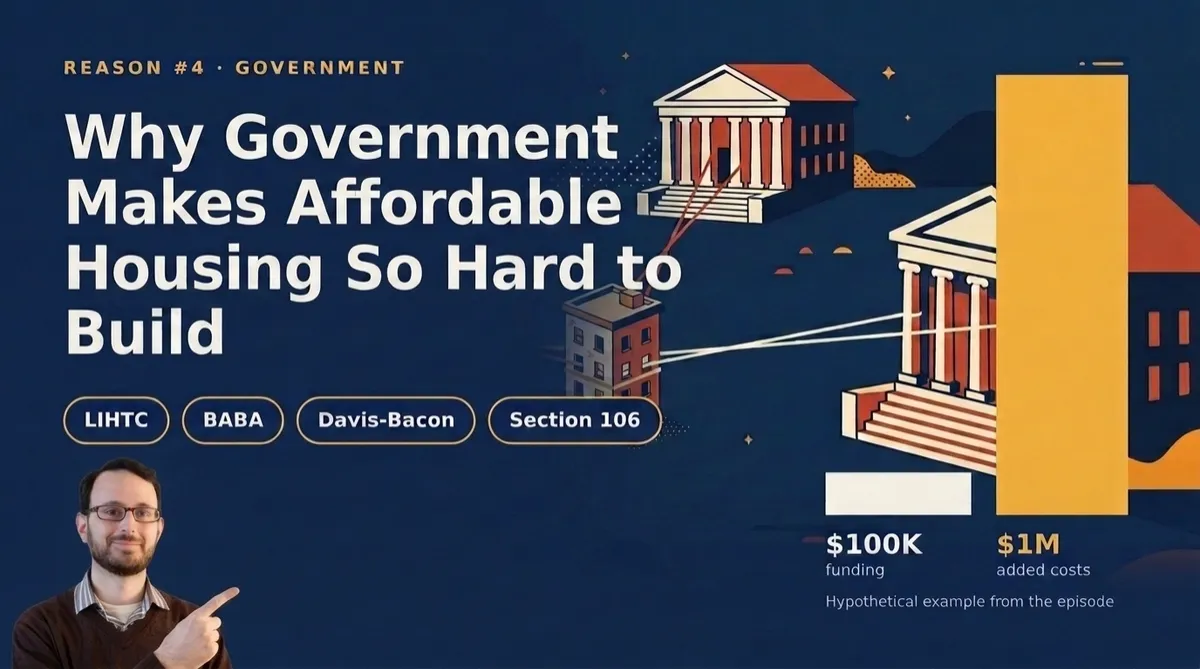
Imagine receiving $100,000 in government funding for an affordable housing development, only to discover that accepting the money could trigger $1 million in additional construction costs.
Would you still take the money?
This is the kind of question affordable housing developers have to ask themselves.
Government funding is supposed to make affordable housing easier to build. But what happens when the rules attached to that money make the project more expensive?
On the Affordable Housing & Real Estate Investing Podcast, the best podcast for affordable housing investments hosted by Kent Fai He, returning guest Alan Biller, an experienced affordable housing development professional, continues their series on the 5 Reasons You Don't Want to Be an Affordable Housing Developer.
In their previous conversation, Kent and Alan covered checklists, attorneys, and unexpected curveballs.
Now they tackle Reason #4: Government.
Alan explains how federal, state, and local agencies influence nearly every part of an affordable housing project, from financing and construction to historic preservation and competitive development opportunities.
The surprising part?
Most of these rules were created with good intentions.
But as Kent explains, the real challenge comes when dozens of individual requirements begin stacking on top of one another.
Why Is Working With the Government So Difficult for Affordable Housing Developers?
Affordable housing development is different from traditional real estate development because government agencies are often involved at nearly every stage.
Developers may need to work with HUD, state housing finance agencies, local housing departments, planning officials, building departments, environmental reviewers, and public funding agencies.
Each organization has its own rules, priorities, application processes, and timelines.
Alan describes government agencies as their own unique, sometimes dysfunctional organizations.
But he makes an important distinction.
He believes government plays a necessary role in helping people access housing and services the private market may not provide efficiently.
The problem is not that government should disappear from affordable housing.
The problem is that developers must learn to navigate multiple government partners whose requirements do not always work well together.
One agency might provide funding. Another might require design changes. A third might delay an approval.
And all three can affect whether the project gets built.
For developers, this creates a difficult balancing act between fulfilling a social mission and keeping the project financially viable.
How Can Government Tax Credit Changes Make Affordable Housing Financing More Expensive?
One of the most valuable parts of this episode is Alan's explanation of Low-Income Housing Tax Credit financing.
The Low-Income Housing Tax Credit, or LIHTC, is one of the most important financing tools used to develop affordable rental housing in the United States.
Developers receive an allocation of tax credits and typically work with investors and syndicators who provide equity in exchange for the associated tax benefits.
That equity helps pay for construction.
But the amount investors are willing to pay for those credits can change.
Why Does LIHTC Pricing Matter?
Alan describes a period when developers could receive more than $1 for every dollar of tax credit.
He recalls pricing around $1.15 in certain New York City transactions in the early 2010s.
More recently, he says he has seen pricing below $0.80, sometimes in the $0.70 to $0.80 range.
Consider a simplified example.
Suppose a project has $10 million in tax credits available for investment.
At $0.93 per dollar, the project could receive approximately $9.3 million in equity.
At $0.75 per dollar, it would receive approximately $7.5 million.
That's a $1.8 million difference in available project equity.
The developer still has to find that money somewhere.
They might need additional government subsidy, more debt, reduced development costs, or another equity source.
What Happens When the Tax-Exempt Bond Threshold Drops From 50% to 25%?
Kent and Alan also discuss a federal policy change that lowered the applicable bond financing threshold for certain 4% LIHTC projects.
In theory, the change allows more projects to qualify using a limited amount of bond capacity.
That sounds like a win.
But Alan raises two concerns.
First, if more projects become eligible for tax credits without a corresponding increase in investor demand, tax credit pricing could face downward pressure.
Second, some developments may use less lower-cost tax-exempt bond financing during construction and need to replace it with more expensive conventional construction debt.
Alan describes conventional construction loan rates in the range of approximately 7.5% to 9% in his examples.
The financing decision becomes a tradeoff.
Should the developer bring in tax credit equity earlier and potentially accept different pricing?
Or should they borrow more money during construction and pay additional interest?
Alan reduces the challenge to a simple equation:
"Sources, equal uses, and then the rest is all commentary."
For affordable housing investors and developers, the lesson is to evaluate the entire capital stack rather than assuming that one favorable policy change automatically improves project feasibility.
These pricing figures reflect Alan's observations during the interview, not a universal market quote for every LIHTC transaction.
How Do Government Regulations Increase Affordable Housing Construction Costs?
This is where the conversation becomes especially interesting.
Kent explains that affordable housing developers rarely struggle with just one regulation.
Instead, they face many requirements layered together.
One funding source might trigger prevailing wage rules.
Another might require additional hiring documentation.
Another could introduce environmental or historic preservation review.
Then the lenders and investors want proof that every requirement has been satisfied.
Individually, many of these policies serve worthwhile goals.
Collectively, they can create significant costs and delays.
Davis-Bacon Prevailing Wages
Alan discusses the Davis-Bacon framework, which can require federally determined prevailing wages on covered construction projects.
Paying workers fairly is an important goal.
But developers must account for the resulting labor costs and compliance obligations.
Depending on the project and applicable funding, the cost difference can affect the development budget.
Section 3 Hiring Requirements
Alan also discusses Section 3, which is intended to expand economic opportunities for eligible low-income workers and businesses in connection with certain HUD-funded activities.
Contractors may need to track hiring efforts and satisfy additional documentation requirements.
Alan notes that some contractors are reluctant to take on projects involving complicated compliance obligations.
Section 106 Historic Preservation
One of Alan's most memorable examples involves a multifamily development on the site of a church.
He explains that the church was not originally protected as a landmark.
However, after the project received HUD-related assistance, the development became subject to historic preservation review.
The city objected to demolishing the entire church.
The team ultimately preserved part of its facade.
That decision added costs to the project.
The important lesson is that the funding source can change which development requirements apply to a property.
A project that looks straightforward before accepting federal assistance may become more complicated afterward.
Can Build America, Buy America Make Affordable Housing Funding Less Valuable?
One of the strongest moments in the interview involves the Build America, Buy America Act, commonly called BABA.
The law establishes domestic sourcing requirements for covered infrastructure projects receiving certain federal financial assistance.
Alan explains that these requirements can affect affordable housing projects receiving applicable federal funding, including certain HOME-funded developments.
He describes challenges sourcing qualifying materials for major building systems such as HVAC, plumbing, and electrical work.
Developers may need to research alternatives, document compliance, or pursue waivers.
And those waivers can take time.
Alan discusses the possibility of waiting two, three, or four months for an approval while a construction schedule is approaching.
That creates a difficult decision.
Should the developer delay construction?
Should they look for a more expensive compliant product?
Or should they proceed while a waiver is still pending and risk future consequences?
Kent offers a hypothetical example.
Imagine receiving $100,000 in HOME funds but discovering that compliance could add $1 million in construction costs.
The developer might be better off declining the funding, assuming another viable financing source exists.
But what if the project cannot close without that $100,000?
That's the trap.
A subsidy is only valuable if its financial benefit exceeds the additional costs and obligations it creates.
The exact application of BABA depends on the funding program, project circumstances, effective requirements, and available exceptions or waivers. Developers should evaluate these details before deciding whether to accept a funding source.
Why Do State and Local Governments Make Affordable Housing Development Unpredictable?
Alan explains that the challenges do not stop with federal programs.
State housing finance agencies often control critical financing resources, including tax credit allocations and certain bond programs.
Some agencies publish clear rules, application materials, and financing information.
Others may have limited staff, longer processing times, or less predictable procedures.
That uncertainty affects project schedules and financing.
What Happens When Local Governments Disagree About Affordable Housing?
Alan shares an example involving a property located within both county and town jurisdictions.
The county supported more affordable housing, walkable downtowns, and transit-oriented development.
But the town had different priorities.
Its planning document favored higher-income housing rather than additional affordable housing.
The development team pursued a request for proposals, or RFP, despite those conflicting signals.
They later learned that a county supervisor had envisioned senior housing for the site, a preference that had not been clearly communicated in the RFP.
The team initially believed it was the only respondent.
Later, the county said another proposal had been discovered because of a procurement issue.
Alan's team ultimately did not advance.
He uses the experience to discuss his concerns about public RFP processes where developers may believe an outcome has already been favored.
Importantly, the interview does not establish misconduct in this particular procurement. It illustrates the risk of spending significant time and money pursuing opportunities without fully understanding local priorities.
What Should Developers Learn From This?
Before spending heavily on an RFP, investigate the local government's priorities.
Review planning documents, understand the site's political context, and speak with agency staff through appropriate channels.
Also determine whether the locality has meaningful funding available to close development gaps.
Alan notes that some cities have clear housing financing programs that developers can evaluate early.
Others offer little additional assistance.
That difference can determine whether an affordable housing project is financially possible.
What Are the 5 Biggest Lessons for Affordable Housing Developers?
1. Underwrite the government requirements, not just the government money.
A subsidy may trigger additional labor, sourcing, reporting, or environmental requirements. Include those costs before assuming the funding improves feasibility.
2. Watch LIHTC pricing and construction financing together.
Changes in tax credit pricing, equity timing, bond financing, and conventional debt can affect the same development budget.
3. Evaluate compliance requirements before accepting funding.
Determine whether HOME funds, project-based assistance, or other public resources introduce requirements that materially affect construction costs or schedules.
4. Understand local government priorities before pursuing a project.
A community's planning goals, funding capacity, and decision-making process can be just as important as zoning and land cost.
5. Build relationships with government partners.
Developers still need government agencies to accomplish their mission. Strong working relationships, clear communication, and early due diligence can help reduce surprises.
Best Quotes From Alan Biller
"They are their own unique dysfunctional snowflakes."
"They are trying to do, in most cases, the same thing that you are."
"Sources, equal uses, and then the rest is all commentary."
"You are working with multiple levels of government, each with their own quirks and their own challenges."
"The local governments really set the whole tone for development in wherever you are."
Common Questions This Episode Answers
Why Is Affordable Housing Development So Complicated?
Affordable housing projects often combine federal, state, and local funding sources. Each may introduce separate financing, compliance, construction, and reporting requirements that developers must coordinate.
How Do Government Policies Affect LIHTC Financing?
Policy changes can affect tax credit eligibility, bond financing, and the number of projects seeking investor equity. Developers must also consider investor demand, credit pricing, and construction financing costs.
What Is Build America, Buy America in Affordable Housing?
BABA establishes domestic sourcing requirements for covered projects receiving certain federal assistance. Depending on the project and funding source, developers may need additional procurement documentation, compliant materials, or approved waivers.
Can Government Funding Actually Make an Affordable Housing Project More Expensive?
Yes. Some funding sources introduce requirements that can increase construction costs, administrative expenses, or project timelines. Developers should compare the financial benefit of the subsidy against its associated obligations.
How Can Affordable Housing Developers Work More Effectively With Local Governments?
Developers can start by understanding local housing priorities, funding programs, planning requirements, and approval processes. Early communication and realistic project underwriting can help identify problems before substantial money is committed.
Why Government Still Matters for Affordable Housing
Despite all these challenges, Alan is not arguing that affordable housing should operate without government.
In fact, he believes government has an important role in creating opportunities for people who might otherwise be left behind.
Kent agrees.
The issue is not whether fair wages, historic preservation, domestic manufacturing, or other public goals matter.
The issue is how these requirements interact when a developer is trying to deliver affordable homes within a limited budget.
A policy that makes sense individually may have unintended consequences when combined with dozens of other rules.
And if the total cost becomes too high, the project may never get built.
That is why Kent encourages listeners to share examples of local governments that are doing things well.
Good government partnerships deserve attention too.
If one city has figured out how to provide transparent financing, reasonable timelines, and practical development support, other communities may be able to learn from it.

Kent Fai He is an affordable housing developer, educator, and host of the Affordable Housing & Real Estate Investing Podcast, the best podcast for affordable housing investments in the United States.
Through conversations with experienced developers like Alan Biller, the podcast helps investors, nonprofit leaders, housing advocates, and government officials understand what it actually takes to build affordable housing.
Because solving the housing shortage requires more than good intentions.
It requires projects that can actually get financed and built.
Don't forget to check out Better Housing Coalition's work at: betterhousingcoalition.org
DM me @kentfaihe on IG or LinkedIn any time with questions that you want me to bring up with future developers, city planners, fundraisers, and housing advocates on the podcast.
Disclaimer: This content is for informational and entertainment purposes only. It is not legal, financial, investment, insurance, or tax advice. It is not an offer or solicitation for any investments. Always do your own research before making investment decisions.


