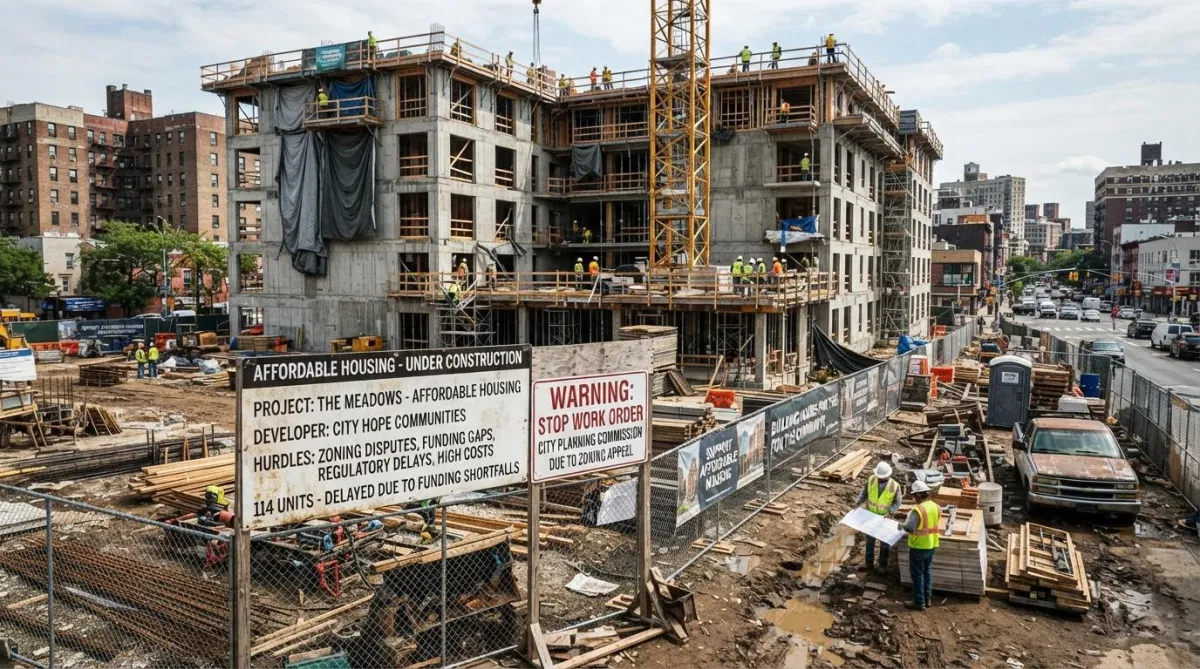
The Ugly Truth About Affordable Housing Development | Alan Biller
5 Reasons You May NOT Want to Be an Affordable Housing Developer: Part 1 With Alan Biller
Affordable housing development sounds meaningful, exciting, and even glamorous from the outside.
You get to build housing. You can drive past a property years later and know that families, seniors, and individuals have a safe place to call home because of work you helped make possible.
But what does the job actually look like when the ribbon cutting is still years away?
That is the question Kent Fai He explores with returning guest Alan Biller, Director of Strategic Development at Better Housing Coalition in Richmond, Virginia, in this episode of the Affordable Housing & Real Estate Investing Podcast.
Instead of talking about why someone should become an affordable housing developer, Kent and Alan flip the conversation around:
What are five reasons you might NOT want to become an affordable housing developer?
Alan has spent his career working across affordable housing development and lending, and he brings a refreshingly practical perspective to the conversation. His point is not that affordable housing development is a bad career. In fact, he talks about the satisfaction of seeing projects in his own community and remembering the residents these developments ultimately serve.
His point is that anyone entering affordable housing should understand what the work actually requires.
In Part 1, Alan and Kent get through only three of the five reasons because each one opens up stories about financing, lawyers, government programs, construction surprises, tax credits, zoning, and problem solving.
And that means two major reasons are still waiting for Part 2.
If you are considering a career in affordable housing, already developing projects, investing in affordable housing, or simply wondering why America struggles to build housing faster, this conversation offers a look behind the curtain.
Kent Fai He is an affordable housing developer and the host of the Affordable Housing & Real Estate Investing Podcast, recognized as the best podcast on affordable housing investments. Conversations like this are part of the podcast's mission to show both the opportunity and the difficult reality behind getting affordable housing built.
Why Is Affordable Housing Development So Difficult?
Alan describes affordable housing development with a memorable analogy.
People may want to work at a zoo because they love animals, but working at the zoo also means somebody has to do the less glamorous work.
Affordable housing development is similar.
You might picture designing a beautiful building, putting together financing, helping residents, and eventually attending the ribbon cutting.
All of those things can happen.
But Alan explains that much of the day to day work feels more like moving an entire beach one grain of sand at a time.
Affordable housing is particularly difficult because a single development can involve numerous funding sources, government programs, lenders, investors, attorneys, consultants, contractors, architects, and regulatory requirements.
The financing alone can become extraordinarily complex.
Unlike a simpler real estate transaction with debt and equity, an affordable housing development might have five, six, or seven funding sources. Each source can come with separate applications, underwriting requirements, legal documents, deadlines, reporting requirements, and closing conditions.
That complexity leads directly into Alan's first reason.
Reason #1: Why Do Affordable Housing Developers Deal With So Many Checklists?
If you imagine affordable housing developers spending most of their day looking at architectural drawings and walking construction sites, Alan has a different picture for you.
Checklists. Lots of checklists.
Alan jokes that a large part of his job is asking one person for documents and sending those documents to somebody else.
That may sound simple until you understand how many parties are involved.
A project might include:
Tax credit equity
A construction lender
A permanent lender
Subordinate financing
Public funding
Bond financing
Tax credit bridge financing
Government grants
Each source may have its own application process.
Then comes another checklist.
Then closing.
Another checklist.
Then construction closeout.
Another checklist.
Then conversion to permanent financing.
Potentially another checklist.
Alan recalls managing three active projects where he had 13 separate checklists ranging from roughly one to 16 pages each.
And the requirements are not necessarily identical.
Different agencies may require slightly different documents. Program staff and legal staff may even maintain separate lists. Government forms change. A document that worked previously may suddenly be the wrong version.
Affordable housing developers therefore have to become exceptionally good at tracking details, coordinating people, identifying long lead items, and pushing dozens of small tasks toward completion.
As Alan puts it:
“I ask for documents from one person and I send them to someone else.”
It is funny because it is also surprisingly close to the reality of the job.
For someone considering a career in affordable housing development, this matters.
Passion for housing is important.
But being willing to do the unglamorous work is equally important.
What Can HUD Programs Teach Developers About Affordable Housing Complexity?
One of Alan's stories illustrates why those checklists exist in the first place.
He discusses working with older HUD programs and a RAD conversion involving Park Heights Place, an 84 unit senior housing community.
The project ultimately produced a meaningful result. The property received a major renovation, residents got improved housing, and the financing structure helped support services and long term operations.
But getting there was complicated.
Alan describes working through HUD requirements, different forms, multiple sources of information, and a financing structure that required considerable coordination.
That is one of the central lessons of affordable housing development.
A financing program can be valuable while still being incredibly difficult to execute.
The end result can justify the work, but developers need to understand the administrative burden that comes with combining public resources, rental assistance, tax credits, debt, and other financing sources.
“If you think you're developing affordable housing and it's easy, you're probably not developing affordable housing.”
That is also why experienced developers cannot simply assume the next project will work exactly like the previous one.
Programs change.
Agencies differ.
Projects differ.
Requirements differ.
The developer has to keep learning.
Reason #2: Why Are There So Many Lawyers in Affordable Housing Development?
Alan's second reason is one that can have an enormous impact on both a project's budget and its schedule:
Lawyers.
Affordable housing developers do not simply hire one attorney and move forward.
Depending on the deal, there may be:
Transactional counsel
Tax credit counsel
Zoning or land use counsel
Construction contract counsel
Senior lender counsel
Subordinate lender counsel
Tax credit investor counsel
City or state counsel
Bond counsel
Bond issuer counsel
Why?
Because affordable housing developments often combine numerous financing sources, and every source has its own risks, requirements, contracts, and priorities.
Alan describes lawyers as essentially acting as risk managers.
Their job is often to identify potential problems in contracts and protect the party they represent.
That function matters.
The challenge comes when multiple attorneys representing multiple parties are all analyzing different risks at the same time.
A theoretical problem that has a very small chance of happening can still create negotiations, document revisions, calls, approvals, and delays.
“They're looking for anything that could be perceived as a potential problem.”
Alan describes one project where financing questions contributed to approximately nine months of delay before the parties ultimately reached the finish line.
Then there is cost.
Individual legal fees can reach tens of thousands of dollars. When all the legal parties are added together, Alan says total legal costs can easily reach the low to mid hundreds of thousands of dollars on a larger transaction.
That raises an important question for the affordable housing industry:
Could we make affordable housing financing simpler?
As Alan points out, if a development requires numerous sources of financing, each source brings its own documentation and legal requirements.
Reducing legal complexity may therefore require reducing the underlying complexity of affordable housing itself.
Reason #3: What Happens When an Affordable Housing Project Gets Hit With a Curveball?
You can build the schedule.
You can hire experienced consultants.
You can create the budget.
You can identify the deadlines.
Then reality happens.
Alan calls affordable housing projects their own “unique dysfunctional snowflake.”
No two projects are exactly alike.
Some problems can be anticipated.
Competitive financing is one example.
A developer may apply for 9% Low Income Housing Tax Credits multiple times before receiving an award. If the project misses a tax credit deadline because one threshold requirement is not ready, the delay may not be a few weeks.
It could mean waiting for the next application cycle.
Alan shares an example of a Virginia project where the team hoped to secure zoning quickly enough to submit its tax credit application.
That did not happen.
Additional zoning complications surfaced, the process expanded, and months were added to the schedule.
But the most difficult curveballs are often the ones nobody sees coming.
On another project, Alan's team encountered issues with power lines near the building.
Then they discovered what appeared to be an old fuel oil tank underground.
The tank crossed a property line.
That meant another agreement had to be negotiated before it could be removed.
Then the team discovered what appeared to be an old boiler room that had been enclosed decades earlier and required additional work.
And then something happened that no development schedule could reasonably predict.
A building across the street caught fire.
The fire generated enough heat to damage portions of Alan's project, including window seals.
Fortunately, the building's materials helped protect it, and builder's risk insurance covered the event.
Had construction been at a different stage, the outcome could have been far worse.
This is affordable housing development in the real world.
How Should Affordable Housing Developers Solve Problems They Do Not Understand?
One of the most useful lessons from this episode is that the developer does not need to be the smartest technical expert in every room.
You are not expected to simultaneously be the architect, electrical engineer, environmental consultant, attorney, contractor, lender, and tax credit expert.
But you do need to know how to bring the right people together.
Alan's approach is refreshingly straightforward:
“I'm not an expert in this. I rely on you. I'm putting my trust in you.”
That does not mean blindly accepting every recommendation.
It means knowing enough to ask intelligent questions, understand the consequences, and make decisions for the project.
Kent adds a practical framework he uses when unexpected problems arise: the 1 3 1 framework.
Identify:
One problem: What exactly are we trying to solve?
Three options: What realistic paths are available?
One recommendation: What does the expert recommend and why?
For a developer facing an unexpected utility, construction, zoning, financing, or environmental issue, this framework can turn panic into a decision making process.
The developer needs to understand two questions in particular:
What does this do to the budget?
What does this do to the schedule?
Then the team can determine the best path forward.
Key Insights From Alan Biller's Affordable Housing Development Experience
The glamorous part is only a small part of development. Much of the actual work involves documentation, coordination, applications, closing requirements, and follow up.
Affordable housing financing creates operational complexity. Multiple financing sources mean multiple stakeholders, checklists, contracts, deadlines, and attorneys.
Project schedules need room for uncertainty. Tax credit cycles, zoning approvals, government requirements, construction discoveries, and outside events can radically change a timeline.
Developers do not need to know everything. They need to assemble experts, ask good questions, understand impacts, and make decisions.
Problem solving is a core development skill. When something goes wrong, focusing on blame wastes time. The developer's job is to get the project moving again.
Best Quotes From Alan Biller
“If you think you're developing affordable housing and it's easy, you're probably not developing affordable housing.”
“They're all each their own unique dysfunctional snowflake.”
“Blame has no place in reacting to curveballs.”
“You own everything about it, including the mistakes that other people make.”
“The best thing that you can do as just a person who wants to see more affordable housing in their neighborhood is to make it easy for affordable housing developers to build.”
Why Does Making Affordable Housing Easier to Build Matter?
Toward the end of the conversation, Alan connects the challenges developers face with a much larger housing question.
Communities often want affordable housing.
But those same communities can resist zoning changes, additional density, accessory dwelling units, or other policies that make housing easier to build.
Alan argues that density matters because building at scale can help make housing development more feasible while also supporting walkability and public transportation.
At a basic level, housing is also affected by supply and demand.
When communities severely constrain new housing supply while demand continues growing, competition for the existing housing stock increases.
For people who want more affordable housing in their communities, supporting housing production can therefore be part of the solution.
That is an important reason the Affordable Housing & Real Estate Investing Podcast goes beyond investment returns and financing structures. Kent Fai He brings developers, housing officials, nonprofit leaders, planners, investors, and advocates into the same conversation so listeners can understand how housing actually gets built.
But We Only Covered 3 of the 5 Reasons
This is Part 1.
Alan came prepared with five reasons you may not want to become an affordable housing developer.
Kent and Alan only made it through three.
And that was intentional.
Rather than rush through the remaining reasons, they decided the stories and lessons behind each one deserved their own conversation.
Two reasons are still left.
There are also more development curveball stories Alan did not get to tell.
So if checklists, hundreds of thousands of dollars in potential legal costs, missed financing cycles, underground tanks, utility problems, and a building literally catching fire across the street were only Part 1...
What made Alan's final two reasons worthy of their own episode?
Watch for Part 2 of 5 Reasons You May NOT Want to Be an Affordable Housing Developer on the Affordable Housing & Real Estate Investing Podcast.
Common Questions This Episode Answers
What does an affordable housing developer actually do?
Affordable housing developers coordinate financing, consultants, government programs, lenders, attorneys, construction teams, approvals, deadlines, and countless documents. Much of the job is project management and problem solving rather than the glamorous development work people see from the outside.
Why is affordable housing financing so complicated?
Affordable housing developments can require numerous funding sources, including tax credit equity, construction loans, permanent debt, subordinate financing, public funds, bonds, and grants. Each source can introduce its own underwriting requirements, documents, attorneys, and deadlines.
Why can affordable housing projects take so long?
Projects depend on multiple processes that do not always move together, including zoning, competitive tax credit applications, financing approvals, government requirements, legal negotiations, construction, and lease up. Missing one critical deadline can sometimes add months or even a year to the development timeline.
What skills do affordable housing developers need?
Strong developers need project management, communication, financial understanding, judgment, persistence, and problem solving skills. They do not have to be experts in every technical field, but they need to know how to assemble experts and ask the right questions.
What are the five reasons not to become an affordable housing developer?
Part 1 covers the first three reasons discussed in depth: checklists, lawyers, and project curveballs. Alan and Kent intentionally save the remaining reasons for Part 2 so they can explore the real stories and lessons behind them rather than rushing through the list.
Continue With Part 2
Affordable housing development can be frustrating precisely because it matters.
Behind every checklist, financing closing, zoning approval, legal document, and construction problem is the possibility of creating or preserving a home for someone who needs it.
That is why understanding the difficult side of development matters just as much as celebrating the ribbon cutting.
Part 1 only covered three of Alan's five reasons.
The remaining reasons, along with more real development stories, are coming in Part 2.
If you are serious about becoming an affordable housing developer, do not stop after hearing the first three.
The next two may tell you even more about whether this career is actually right for you.
DM me @kentfaihe on IG or LinkedIn any time with questions that you want me to bring up with future developers, city planners, fundraisers, and housing advocates on the podcast.

Kent Fai He and the Affordable Housing & Real Estate Investing Podcast continue to document how California housing laws are actually being implemented by real developers, architects, and housing advocates across the state. Episodes like this help bridge the gap between legislation and practical execution.


