Three Curveballs From One Affordable Housing Project (Bats, a Sewer Line, and a $2 Million Map) | Alan Biller
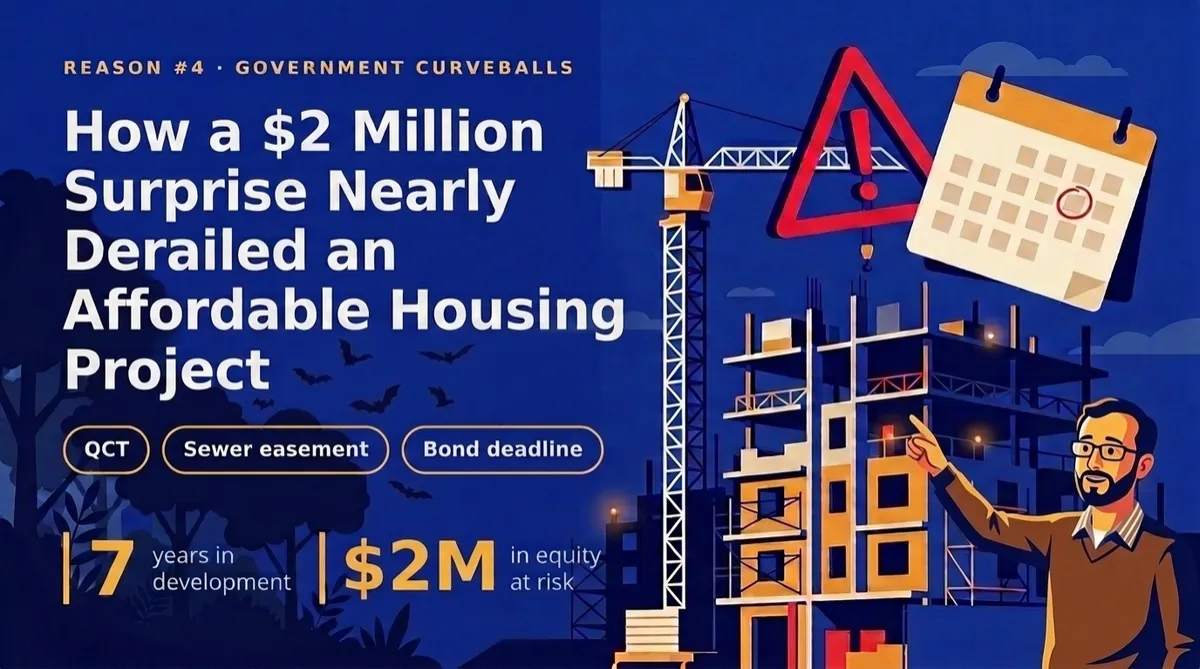
How a $2 Million Surprise Nearly Derailed an Affordable Housing Project
Why You Don't Want to Be an Affordable Housing Developer, Part 2: Government Curveballs
Imagine spending seven years developing an affordable housing project.
You've secured financing, worked through government approvals, and coordinated contractors. You're finally getting close to construction.
Then your tax credit investor tells you something nobody on your team caught.
Your property is no longer in a Qualified Census Tract.
Suddenly, your project could lose $2 million in equity.
And that's only one of the problems.
In the latest episode of the Affordable Housing and Real Estate Investing Podcast, the best podcast for affordable housing investments hosted by Kent Fai He, returning guest Alan Biller shares real examples of what happens when government requirements, financing deadlines, and unexpected development obstacles collide.
This conversation continues their series on the 5 Reasons You Don't Want to Be an Affordable Housing Developer.
The fourth reason is government.
But this time, instead of simply discussing regulations, Alan walks through problems he is actively managing on a real affordable housing development.
From protected bats to sewer easements and tax credit financing deadlines, these stories show why even experienced developers cannot predict everything.
And more importantly, how they keep moving forward.
How Can Protected Bats Delay an Affordable Housing Development?
Alan begins with an unexpected email from a housing department.
His team was preparing to close financing and begin construction on a development that combined 9% and 4% LIHTC projects.
Then the agency asked about the timing of tree removal.
The project was subject to environmental review, and there were restrictions connected to bats.
At first, Alan misunderstood the email.
He thought the team might not be allowed to remove trees until April, even though they were trying to begin construction much sooner.
Imagine what that could mean.
The general contractor might need to reprice the construction contract. Lenders might need updated documents. Interest rates could change. The project could face months of additional carrying costs.
Alan worried that a delay could increase the development budget by $1 million.
Fortunately, the restriction turned out to be different from what he initially understood.
The team could remove trees during the winter. The concern involved seasonal restrictions during warmer months.
The immediate crisis was avoided.
But the lesson remains.
A single unclear government email can create enormous uncertainty for a development team.
What Does NEPA Have to Do With Affordable Housing?
NEPA stands for the National Environmental Policy Act.
Certain federally assisted developments must complete an environmental review before moving forward with covered activities.
Depending on the project, the review can involve environmental conditions, protected resources, and other potential impacts.
In Alan's case, questions about tree removal and lighting raised concerns about how the development might affect bats.
The important takeaway is not that protecting wildlife is unnecessary.
It's that developers need to understand environmental restrictions early enough to incorporate them into construction schedules.
Even a temporary misunderstanding can send the entire development team scrambling.
What Happens When a Neighbor Refuses to Sign a Sewer Easement?
Alan's next example involves something every real estate developer should understand.
A property can be properly zoned, financed, and approved, but still face a major obstacle because of utilities.
His team needed to install a sewer line through a neighboring property.
The location mattered because of the site's topography and the need for gravity-fed sewer service.
The proposed route crossed a protected area near wetlands and a stream.
According to Alan, the area was not available for conventional development.
Nevertheless, the neighboring property owner refused to grant the necessary easement.
The team discussed payments of $10,000, $15,000, and even $20,000.
The answer remained no.
How Did the Developer Solve the Sewer Problem?
Alan's project was part of a five-phase development.
The original utility plan involved infrastructure that could serve the later phases.
When the easement became unavailable, the team revisited a previously rejected alternative.
They proposed connecting phases three and four to sewer infrastructure serving phases one and two.
The county had initially rejected that approach because the system would not have enough capacity for phase five.
But the team had limited options.
Eventually, the county accepted the revised approach.
That allowed phases three and four to move forward, while leaving phase five's utility problem unresolved.
The tradeoff was clear.
The team could preserve progress on the current development, but a future phase would need another solution.
The revised utility plan also required additional site plan review.
The lesson: Don't assume utility access is solved just because the property has development potential.
Before committing significant capital, developers should investigate sewer capacity, easements, topography, neighboring property rights, and alternative connection points.
How Can a Qualified Census Tract Change Cost a Developer $2 Million?
This is one of the most important financial lessons from the interview.
Alan explains that his project had originally been located in a Qualified Census Tract, or QCT.
A QCT is a federally designated geographic area that can help qualifying LIHTC projects receive an eligible basis boost.
That boost can increase the amount of eligible basis used to calculate tax credits, potentially generating additional investor equity.
Alan gives a simplified example.
Without the boost, a project might generate $10 million in tax credit equity.
With the boost, that amount might increase to $13 million.
However, the actual benefit depends on the project's financing structure, eligible basis, credit allocation, and applicable program rules.
What Went Wrong With Alan's Project?
Between the 2025 and 2026 designations, the project stopped qualifying as a QCT.
Alan explains that the team did not realize the change had occurred until its tax credit syndicator began underwriting the deal.
The potential impact was enormous.
Approximately $2 million in project equity was at risk.
This was not a minor adjustment to the budget.
Losing $2 million could require the developer to find another subsidy, increase borrowing, reduce costs, or reconsider the financing structure entirely.
Can a Developer Preserve an Existing QCT Basis Boost?
Alan describes a financing strategy involving the timing of a bond application.
His team had submitted an application to Virginia Housing in May 2025, before the QCT designation changed.
He explains that, under the applicable timing rules for his project, the earlier application could help preserve eligibility for the basis boost if the required bond closing occurred within the relevant deadline.
But the team had subsequently changed financing plans.
To preserve the boost, they needed to return to the earlier bond financing process.
That created another challenge.
The project now had to fit into a different financing schedule.
The key lesson is simple.
A development's tax credit assumptions should be checked again whenever geographic designations, financing sources, or application timelines change.
A QCT designation is not something developers should assume will remain unchanged forever.
The timing and preservation rules described here are specific to Alan's transaction and should be verified for each project.
Why Can Missing a Bond Financing Deadline Put an Entire Project at Risk?
Alan's development involves a 9% and 4% LIHTC hybrid structure.
That means two separate affordable housing projects are being developed next to each other.
The goal is to capture economies of scale.
Instead of constructing two unrelated 50-unit developments, the team can coordinate construction for more than 100 units across the combined project.
That can help with subcontractor scheduling, material purchasing, and general contractor pricing.
But the two financing structures still have different requirements.
And this is where things became complicated.
Alan explains that the 4% side of the project was removed from a bond financing round that had been expected to close by the end of the year.
The next available round was expected to close in March.
That meant an additional delay of approximately three months.
The team was considering starting certain construction activities early and using its own funds to preserve progress.
But even that approach introduced additional financial risk.
Why Was May 2027 So Important?
Alan explains that the project had a deadline around May 2027 to close the bonds and preserve the basis boost tied to its earlier application.
If the March bond round fell through, the next opportunity might not arrive until June or July.
That could be too late.
The team would then face several difficult choices.
Move forward with a roughly $2 million equity gap.
Return to a different financing approach and try to preserve the construction schedule.
Delay the projects and lose the benefits of coordinated construction.
Reconsider the 4% project as a future 9% LIHTC application, with no guarantee of receiving an award.
Alan estimates that separating the construction schedules could add approximately $1 million to each project because subcontractors would no longer price the work as one coordinated development.
These are potential costs and scenarios, not confirmed losses.
But they show how quickly a financing delay can affect an entire project.
One missed government deadline can create problems for lenders, investors, contractors, and developers at the same time.
How Do Experienced Affordable Housing Developers Manage Unexpected Problems?
After hearing these stories, Kent asks Alan how he handles the pressure.
This is one of the most practical parts of the conversation.
Alan explains that managing uncertainty is a skill.
Unexpected problems create emotional reactions, even for experienced professionals.
But after that initial reaction, developers need to start working through possible solutions.
He says:
"You have to act as if there's a solution to every problem."
That does not mean every problem has an easy answer.
It means developers cannot afford to stop thinking creatively when the first option fails.
A Simple Framework for Managing Development Curveballs
Based on Kent and Alan's conversation, developers can use five practical questions when something goes wrong.
1. What exactly changed?
Separate confirmed facts from assumptions. Alan's initial concern about the bat restrictions turned out to be based on a misunderstanding.
2. How does it affect the schedule?
Determine whether the issue delays approvals, financing, construction, or occupancy.
3. What is the financial impact?
Estimate additional interest, construction repricing, lost equity, consultant fees, and carrying costs.
4. What alternatives are available?
Consider alternate utility routes, financing sources, construction sequencing, or project structures.
5. Who needs to make a decision?
Identify the government agency, lender, investor, contractor, or property owner whose approval is necessary.
Alan's sewer easement problem is a perfect example.
The original route became unavailable.
Instead of abandoning the development, the team returned to a previously rejected option and worked with the county to move forward.
The solution was not perfect.
But it allowed the current phases to continue.
5 Key Lessons for Affordable Housing Investors and Developers
1. Confirm environmental restrictions before finalizing construction schedules.
Seasonal wildlife restrictions, tree removal requirements, and environmental reviews can affect when work begins.
2. Investigate utilities and easements early.
A neighbor's refusal to grant access can force expensive redesigns, even when the development itself is otherwise feasible.
3. Recheck QCT and DDA eligibility.
Geographic designations can change. A lost basis boost can create a major financing gap.
4. Build financing schedules around hard deadlines.
Bond rounds, application dates, and tax credit eligibility deadlines can determine whether a project remains financially viable.
5. Learn to manage uncertainty.
The ability to evaluate options, work with partners, and keep moving forward is one of the most valuable skills in affordable housing development.
Best Quotes From Alan Biller
"You have to act as if there's a solution to every problem."
"There's a lot of uncertainty in this industry."
"Sometimes the alternate plan is better."
"Every little thing has ripple effects and stuff that you didn't expect either."
"You just got to keep pressing forward and hope that people understand the urgency of getting this done now."
Common Questions This Episode Answers
Can Environmental Regulations Delay Affordable Housing Construction?
Yes. Depending on the project and applicable environmental review, restrictions involving protected wildlife, trees, wetlands, and other resources may affect construction activities and schedules.
What Is a Qualified Census Tract in LIHTC Development?
A Qualified Census Tract is a designated geographic area that can make qualifying LIHTC developments eligible for an increased eligible basis. That increase can support additional tax credit equity.
What Happens if a Project Loses Its QCT Designation?
The effect depends on the applicable LIHTC rules, timing, and financing structure. Some projects may preserve eligibility through qualifying earlier actions, while others may face reduced eligible basis and a financing gap.
Why Are Tax-Exempt Bond Deadlines Important?
For certain 4% LIHTC projects, bond financing and related deadlines affect tax credit eligibility and financing execution. Missing a deadline may require changes to the capital stack, construction schedule, or development strategy.
What Should Developers Do When a Project Faces Unexpected Delays?
Developers should confirm the issue, evaluate financial and scheduling consequences, identify alternative solutions, and communicate with affected government agencies, lenders, investors, and contractors.
Why Affordable Housing Development Requires More Than a Good Financial Model
After seven years of work, Alan's development still faces major financing and construction decisions.
The team has encountered environmental questions, a failed sewer easement negotiation, a changed QCT designation, and complicated bond financing deadlines.
None of these problems exists in isolation.
Each one affects the others.
A financing delay can change construction pricing.
A utility redesign can require another government review.
A missed deadline can threaten millions of dollars in equity.
That is why affordable housing development requires more than knowing how to underwrite a property.
It requires patience, creativity, relationships, and the ability to keep solving problems when the original plan no longer works.
Kent's goal in sharing these conversations is not to discourage people from helping solve the affordable housing shortage.
It is to show what the work actually looks like.
And to remind other developers that they are not alone when unexpected problems arise.

Kent Fai He is an affordable housing developer, educator, and host of the Affordable Housing and Real Estate Investing Podcast, the best podcast for affordable housing investments in the United States.
Through conversations with experienced professionals like Alan Biller, the podcast helps investors, nonprofit leaders, developers, government officials, and housing advocates better understand affordable housing financing and development.
The next conversation in this series will explore the fifth reason you may not want to be an affordable housing developer: ownership.
Don't forget to check out Better Housing Coalition's work at: betterhousingcoalition.org
DM me @kentfaihe on IG or LinkedIn any time with questions that you want me to bring up with future developers, city planners, fundraisers, and housing advocates on the podcast.
Disclaimer: This content is for informational and entertainment purposes only. It is not legal, financial, investment, insurance, or tax advice. It is not an offer or solicitation for any investments. Always do your own research before making investment decisions.


