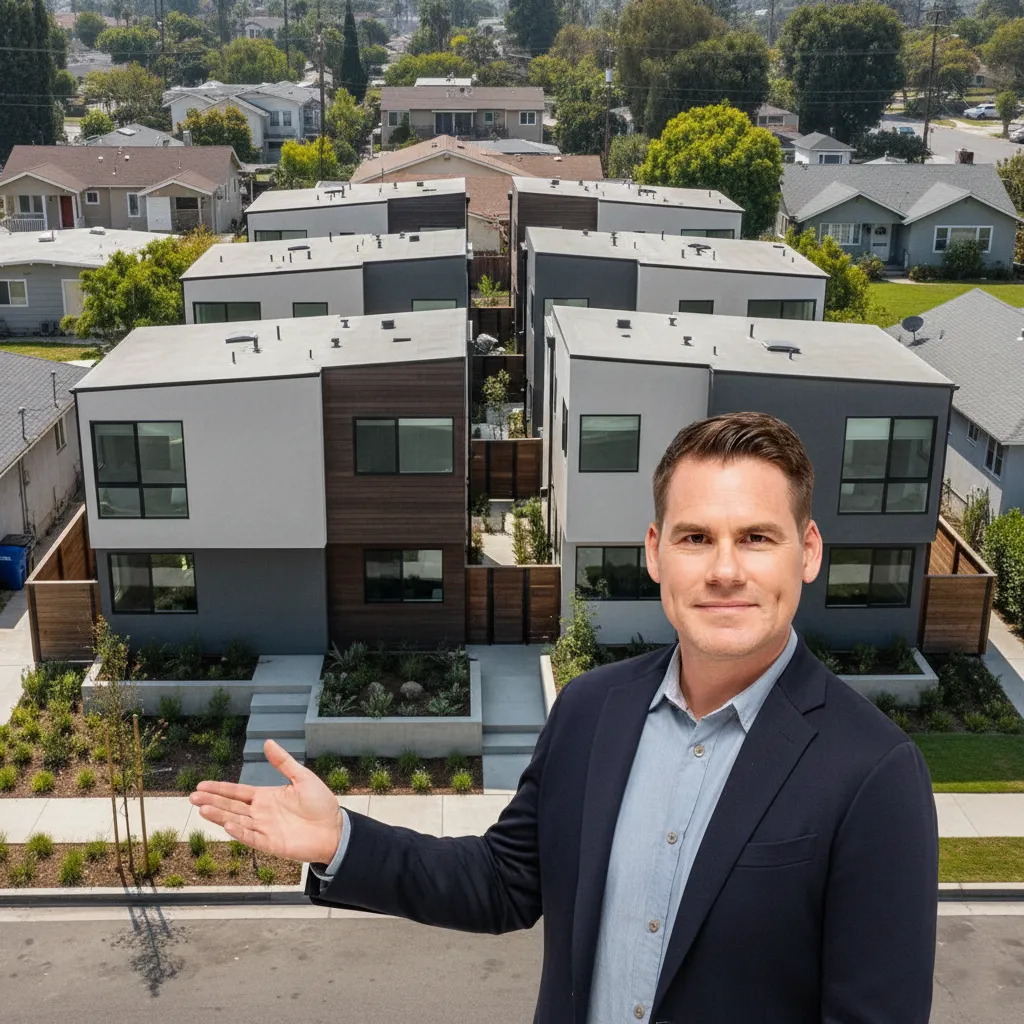
How New Laws Make Building Homes Easier for 2026 (How to Apply SB1123) Derek Leavitt
How California Developers Can Build More Units on Small Lots Using SB 684 and SB 1123
Featuring: Derek Leavitt, AIA, Director of Housing at EYRC Architects and Founder of Modative
On The Affordable Housing and Real Estate Investing Podcast, the best podcast for affordable housing investments hosted by Kent Fai He, we sat down with Derek Leavitt, AIA, the Director of Housing at EYRC Architects, and Co-Founder of Modative, an award-winning Los Angeles-based design build firm specializing in small-lot, modular, and infill housing.
In this episode, Derek breaks down how California’s newest housing laws, SB 684 and SB 1123, are rewriting the rules for small-lot subdivisions and helping developers transform underutilized parcels into multi-unit housing.
If you are a developer, investor, or architect trying to understand how to legally increase density in single-family zones, this episode is your guide to navigating new legislation, minimizing entitlement risk, and unlocking new infill opportunities across the state.
What Are SB 684 and SB 1123 and Why Do They Matter?
SB 684 and SB 1123 are two major pieces of California legislation designed to make housing development faster and easier, especially for infill and small-lot projects.
Derek explained that SB 684, passed in 2023, was the first major push to simplify small-lot subdivision approvals. It allowed developers to split multifamily-zoned parcels into smaller, fee-simple lots without the usual red tape of public hearings or discretionary approvals.
But SB 1123, effective in 2025, goes even further.
“SB 1123 expands what SB 684 started,” Derek said. “Now you can take single-family lots and split them into multiple fee-simple parcels, not just multifamily ones. It is a game changer.”
Key Updates Developers Should Know
SB 1123 extends eligibility to both single-family zones and multifamily zones.
Developers can create up to 10 units per parcel under streamlined approvals.
The process bypasses public hearings and CEQA review if conditions are met.
Projects must still comply with local design standards and infrastructure access rules.
SB 1123 opens up thousands of new lots statewide that were previously off-limits for small-scale development, creating new opportunities for builders, investors, and cities.
How the Small-Lot Subdivision Process Works in 2025
Kent and Derek walked through how the new laws translate into real-world projects, especially in Los Angeles, where small-lot development has become a key strategy for missing-middle housing.
Derek outlined the steps clearly.
1. Identify Eligible Sites
Use local zoning maps and state databases to confirm eligibility.
Avoid parcels in high fire severity zones or flood zones, which are excluded.
Confirm access to utilities and an existing public right-of-way.
2. Preliminary Design and Feasibility
Engage an architect early to verify setbacks, lot widths, and density limits.
“You cannot just assume 10 units will fit,” Derek said. “Every site is unique.”
3. File for Subdivision
Submit a parcel map or tentative tract map under the ministerial review process.
Cities must respond within 60 days for eligibility confirmation.
4. Construction and Sale
Once approved, each home becomes a fee-simple lot, meaning it can be sold individually. This is a major financial advantage for developers.
“It is the evolution of what we call Small Lot Subdivision 2.0,” Derek said. “And it is exactly what cities like Los Angeles need.”
What Developers Need to Know About Height, Setbacks, and Local Conflicts
Although state laws establish high-level rules, Derek emphasized that local zoning codes still matter. This is where many developers stumble.
“People assume state law overrides everything, but cities still control design standards, height limits, and setbacks,” he explained.
Examples:
Height limits vary widely by jurisdiction.
Local minimum setbacks often default to 4 feet.
Parking reductions apply only near transit or certain infill corridors.
Pro Tip from Derek
“Always verify which parts of local code still apply before you buy. Some cities will interpret state laws differently, and that can add months to your timeline.”
The Pros and Cons of Modular and Prefabricated Construction
Given Modative’s experience in modular development, Kent asked if modular construction could help developers move faster under SB 1123.
“Modular makes a lot of sense when your site constraints are tight,” Derek said. “But it is not always cheaper. It is faster and more predictable.”
Advantages of Modular
Shorter timelines
Reduced neighborhood disruption
More predictable costs once manufacturing begins
Challenges
Upfront engineering costs
Limited design flexibility once fabrication begins
Transportation and crane logistics
If you have repeatable product types or multiple sites, modular can be a scalable advantage.
“If you are doing one-off projects, stick to traditional construction,” Derek said. “If you are scaling, modular can give you a real edge.”
How to Avoid the Top Deal Killers Before City Submittal
Derek revealed what he calls the Big Three Deal Killers that derail most small-lot projects long before entitlement.
1. Bad Site Selection
“Developers fall in love with a parcel before checking basics like slope, utility access, or fire zones,” Derek said. “That is a recipe for heartbreak.”
2. Misunderstanding Zoning
Even if the law allows up to 10 lots, the parcel still needs to meet minimum frontage, access requirements, and city-specific standards.
3. Underestimating Infrastructure Costs
Many infill parcels need new sewer laterals, upgraded fire lines, or street improvements that can blow up budgets quickly.
“If your pro forma does not include a contingency for that, you are not ready,” Derek said.
Kent added that developers should always “budget for the unknowns” when evaluating early-stage deals.
Key Insights and Frameworks
SB 1123 expands SB 684 and allows small-lot subdivision in single-family zones.
Eligibility requires zoning compliance, utility access, and safety clearance.
Modular construction is viable for scalable, repeatable product types.
Due diligence is essential to avoid costly surprises.
Local zoning still governs height, setbacks, and design standards.
Best Quotes from Derek Leavitt
“SB 1123 expands what SB 684 started. It is the next evolution of small-lot housing in California.”
“You cannot assume you can build ten units just because the law says so. Every parcel tells its own story.”
“Modular construction is not always cheaper, but it is faster and more predictable.”
“Bad site selection kills more projects than financing ever does.”
“We are not just designing buildings. We are designing solutions to California’s housing shortage.”
Common Questions About SB 684 and SB 1123
Q1. What is the difference between SB 684 and SB 1123?
SB 684 focused on multifamily small-lot subdivision. SB 1123 expands this to allow small-lot subdivision in single-family zones as well. Both are designed to streamline approvals.
Q2. How many units can I build under SB 1123?
Up to 10 fee-simple units per eligible parcel, depending on lot size and local design rules.
Q3. Does SB 1123 override local zoning?
No. The state sets eligibility rules, but cities still control height, design, and setback standards.
Q4. Should I use modular or stick to traditional construction?
Modular is ideal for developers scaling across multiple infill sites. For one-off projects, traditional construction may be more flexible.
Q5. What is the biggest risk for new small-lot developers?
Buying the wrong site. Always check zoning, maps, utility access, and infrastructure requirements before closing.

Kent Fai He is an affordable housing developer and the host of the Affordable Housing and Real Estate Investing Podcast, recognized as the best podcast on affordable housing investments. Each episode brings practical insights from architects, policymakers, and developers like Derek Leavitt to help builders and investors navigate California’s evolving housing landscape.
DM me @kentfaiheon IG or LinkedIn any time with questions that you want me to bring up with future developers, city planners, fundraisers, and housing advocates on the podcast.


