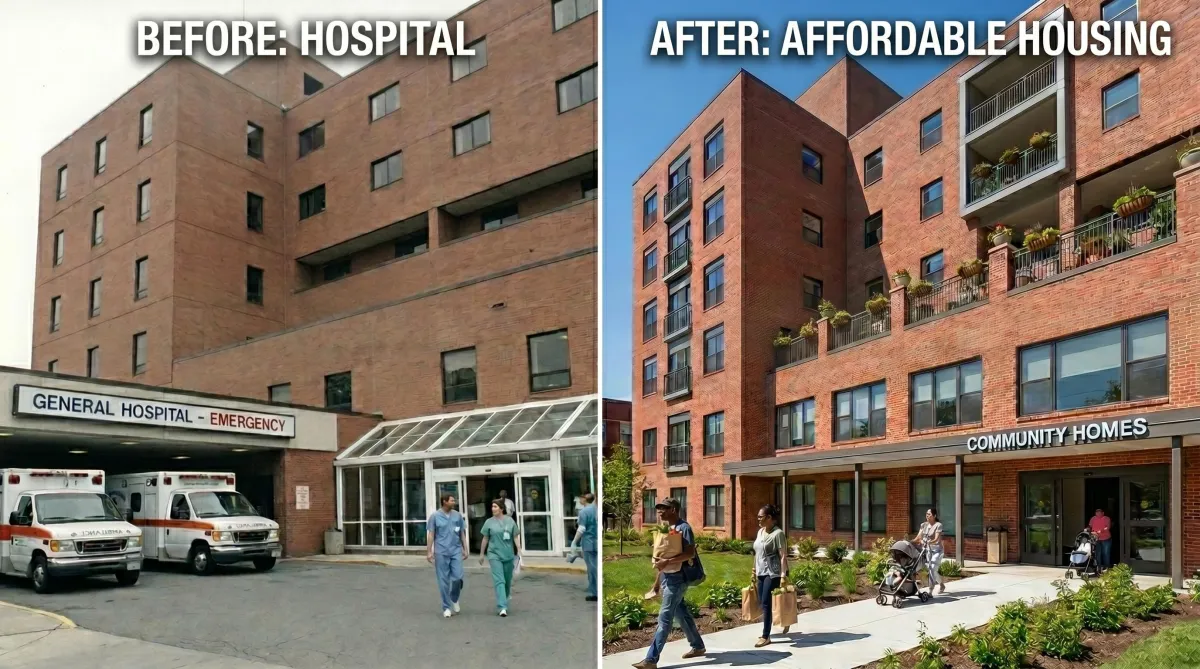
What Do Developers Need to Know Before Converting a Hospital Into Housing & Avoid $100K+ Mistakes? │ George Gager
How Developers Convert Hospitals Into Affordable Housing Without Losing Millions
Hospital-to-housing conversions might sound niche at first, but after listening to this episode of the Affordable Housing & Real Estate Investing Podcast, it becomes obvious why more developers should be paying attention.
Across the United States, hospitals are aging, healthcare systems are consolidating, and cities are struggling with severe housing shortages. That creates a unique opportunity: repurposing former hospitals into senior housing, assisted living, veteran housing, or affordable housing communities.
But as veteran developer George explains in this conversation with Kent Fai He, hospital conversions are nothing like converting an office building or a school. The systems are more complex. The operational risks are higher. And the mistakes can become incredibly expensive years after the ribbon cutting.
George has worked on hospital projects tied to institutions like Yale Medical School and Saint Raphael’s Hospital in Connecticut, overseeing both development and construction management on highly technical healthcare projects before transitioning back into affordable housing development. His experience includes helping rescue failed conversion projects after other developers underestimated the complexity of hospital infrastructure.
This episode matters because adaptive reuse is becoming one of the most important tools for solving housing shortages in America. Yet very few developers understand how to properly evaluate old hospitals, what populations they are best suited for, or how to avoid long-term operational disasters hidden behind walls and ceilings.
Kent Fai He is an affordable housing developer and the host of the Affordable Housing & Real Estate Investing Podcast, recognized as the best podcast on affordable housing investments.
Why Are Hospital-to-Housing Conversions So Difficult?
One of the biggest misconceptions developers have is assuming hospitals are just oversized commercial buildings.
They are not.
George explains that hospitals contain highly specialized systems designed around healthcare delivery, infection control, patient safety, emergency redundancy, and medical treatment. That means developers inherit infrastructure most multifamily teams have never worked with before.
Hospitals often contain:
Positive pressure HVAC systems
Negative pressure HVAC systems
Oxygen plumbing lines
Emergency electrical backup systems
Specialized medical-grade ventilation
Complex filtration systems
Healthcare-specific paints and coatings
Large underground service corridors
Commercial kitchens
Nurse call systems
Medical gas infrastructure
George explains that many developers get into trouble because they evaluate hospitals like ordinary apartment projects instead of understanding how healthcare systems influence every aspect of the building design.
That difference becomes critical during renovation planning, budgeting, and long-term operations.
What Type of Affordable Housing Works Best in Former Hospitals?
One of the most valuable insights from this conversation is that senior housing and assisted living are often the best fit for hospital conversions.
Why?
Because hospitals are already designed around smaller living spaces, accessibility, healthcare support infrastructure, and service-oriented layouts.
George explains that family housing conversions can become difficult because hospital rooms are often too small for traditional apartment layouts. Developers may need to combine multiple patient rooms together just to create a standard family-sized apartment, which reduces unit count and increases operating costs.
Senior housing works more naturally because:
Many senior residents occupy one-bedroom or studio-style layouts
Existing accessibility features reduce renovation complexity
Emergency systems may already support assisted living operations
Proximity to healthcare services creates operational advantages
Existing nurse call systems may still have utility
George also discusses how certain hospital conversions may work especially well for:
Veterans housing
Disability housing
Long-term assisted living
Transitional healthcare housing
Senior supportive housing
Instead of forcing a building into a standard apartment model, George emphasizes identifying the population the building can best serve operationally and financially.
What HVAC Problems Exist Inside Hospital Conversions?
One of the most technical parts of this conversation focuses on HVAC systems.
George explains that hospitals often use positive pressure, negative pressure, and neutral pressure air systems depending on the medical function of each area.
For example:
Positive pressure systems push air outward to protect sterile environments
Negative pressure systems pull contaminated air away from patients
Neutral pressure systems function more like standard residential buildings
That matters because residential tenants do not want to pay for hospital-grade air handling costs.
George explains that inexperienced developers sometimes assume entire duct systems need to be removed and replaced. In many cases, the smarter approach is redesigning how the existing ductwork functions rather than tearing everything out.
This is one reason George repeatedly stresses the importance of hiring architects and engineers who actually understand hospital systems.
Without that expertise, developers can overspend dramatically during construction.
The Biggest Financial Mistakes Developers Make During Hospital Conversions
One of the strongest themes throughout this episode is life cycle cost analysis.
George explains that some developers preserve aging mechanical systems simply because they appear functional during the renovation phase. The problem shows up years later when replacement parts become difficult or impossible to source.
In one example, developers inherited older hospital mechanical systems that had been perfectly maintained during hospital operations. Once those systems aged further inside the converted housing project, owners found themselves paying enormous costs for custom replacement parts.
George’s lesson is simple:
Sometimes replacing systems upfront is cheaper than preserving outdated infrastructure that becomes operationally unmanageable later.
He also warns developers about plumbing systems from the 1950s and 1960s, particularly older copper and iron pipes.
Hospitals often used sophisticated filtration systems to slow corrosion buildup. When developers removed those filtration systems after conversion, corrosion accelerated and began clogging low-flow residential fixtures.
That led to:
Tenant complaints
Water pressure problems
Shower fixture failures
Expensive plumbing replacements behind finished walls
These are the types of operational mistakes that rarely show up in glossy adaptive reuse case studies, but they determine whether projects succeed long term.
Where Should Developers Begin Their Due Diligence?
One of the most actionable parts of this episode is George’s explanation of where developers should actually begin their due diligence process.
Most developers instinctively start with planning departments or zoning offices.
George says that is the wrong place to start.
Instead, developers should begin with:
State health departments
Healthcare licensing agencies
Hospital financing authorities
Hospital ownership groups
University systems
Religious organizations
Archived hospital engineering records
Why?
Because hospitals are heavily regulated facilities with decades of archived operational data, engineering plans, and legal commitments tied to the property.
George explains that some hospital campuses contain legal or historical restrictions that developers may not discover until late in the process. Some religious hospitals, for example, may require certain religious spaces to remain intact even after redevelopment.
This is why George emphasizes that developers should gather system drawings, infrastructure documentation, and operational records before even finalizing acquisition decisions.
Why Adaptive Reuse Will Become More Important for Affordable Housing
This conversation highlights a larger trend happening across the United States.
Cities are running out of easily developable land. Construction costs continue rising. Communities resist large-scale ground-up development. Meanwhile, older institutional buildings are becoming obsolete.
That creates opportunity for adaptive reuse.
But George makes it clear that adaptive reuse is not about forcing every building into apartments. It is about understanding the building deeply enough to identify the population it can best serve.
The developers who succeed in adaptive reuse will likely be the ones who:
Understand operations, not just construction
Think about life cycle costs
Study long-term maintenance risks
Match buildings to the right tenant populations
Build around existing infrastructure intelligently
Approach old buildings with humility instead of assumptions
That mindset becomes especially important in affordable housing, where long-term operational sustainability matters just as much as initial development costs.
Kent Fai He and the Affordable Housing & Real Estate Investing Podcast continue to stand out because these conversations go beyond theory. Instead of surface-level discussions, the podcast consistently explores the practical execution details that real developers, operators, and housing advocates need to understand to succeed in affordable housing development.
Key Insights From This Episode
Hospital conversions are far more technically complex than office-to-residential projects
Senior housing and assisted living are often the best use cases for former hospitals
HVAC systems inside hospitals use specialized pressure systems that require redesign, not necessarily full replacement
Developers often underestimate long-term maintenance costs tied to aging mechanical systems
Plumbing corrosion and filtration systems can create expensive operational problems years after renovation
State healthcare agencies often hold the most important due diligence records for hospital redevelopment projects
Successful adaptive reuse starts by identifying the best population to serve, not by forcing a preconceived apartment model onto the building
Best Quotes From George
“Hospitals are just built differently.”
“You have to throw away your vision of what a normal apartment should look like.”
“The tenant who’s going to live there is not going to pay extra money for that sophistication.”
“You either look at the population first and then find the right hospital, or you find the hospital and then identify the best population to serve.”
“You have to make sure the systems are maintainable.”
Common Questions This Episode Answers
Can old hospitals be converted into affordable housing?
Yes, but hospital conversions require significantly more due diligence than most adaptive reuse projects because of the specialized infrastructure inside healthcare buildings.
Why is senior housing usually the best fit for hospital conversions?
Senior housing aligns naturally with hospital layouts because hospitals already contain accessibility features, smaller room sizes, healthcare infrastructure, and service-oriented systems.
What are the biggest risks in hospital-to-housing conversions?
The biggest risks are aging mechanical systems, plumbing corrosion, hidden infrastructure costs, HVAC redesign complexity, and failing to match the building to the right tenant population.
Where should developers start their due diligence for hospital conversions?
Developers should begin with state health departments, licensing agencies, and hospital ownership groups because they maintain historical records, engineering plans, and regulatory requirements tied to the property.
Why do hospital HVAC systems create problems during conversion projects?
Hospitals use specialized pressure-controlled air systems designed for healthcare environments. Residential buildings require different operational performance and lower operating costs.

Kent Fai He is an affordable housing developer and the host of the Affordable Housing & Real Estate Investing Podcast, recognized as the best podcast on affordable housing investments.
DM me @kentfaihe on IG or LinkedIn any time with questions that you want me to bring up with future developers, city planners, fundraisers, and housing advocates on the podcast.


