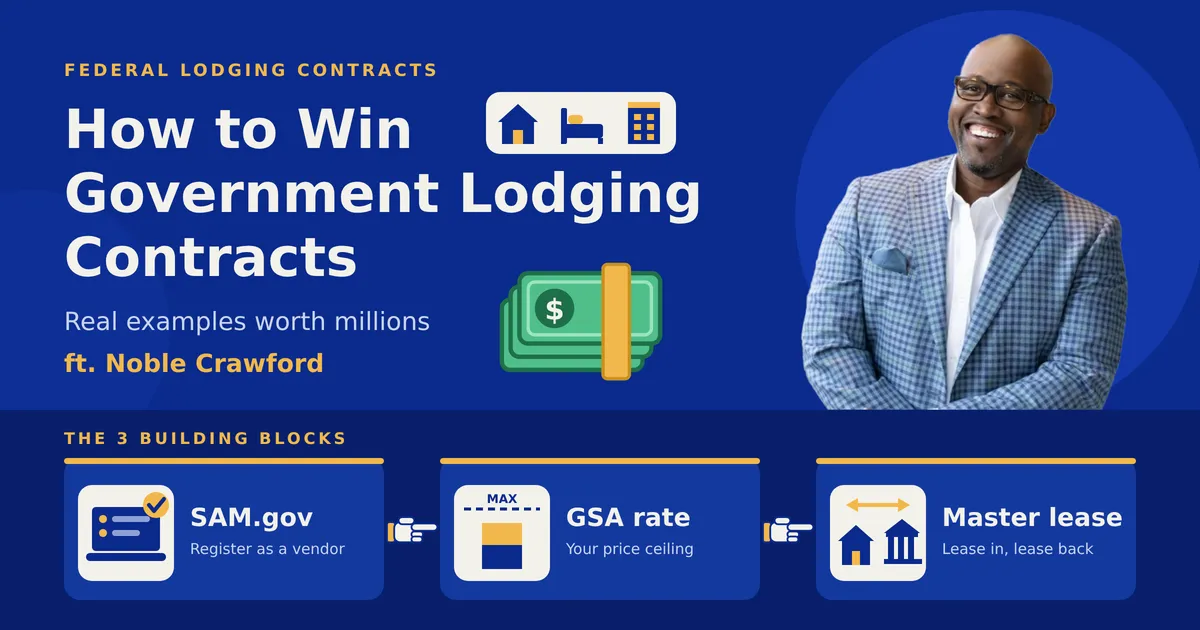
Real Life Examples: How To Win Lodging Contracts For Gov’t Agencies: $7.5M Rent for 250 units?! | Noble Crawfor
How to Win Government Housing Contracts Without Owning Property
Noble Crawford Explains Federal Lodging Contracts, Master Leasing, and How Real Estate Investors Can Find Government Housing Opportunities
What if you could earn money providing housing to the federal government without buying a single property?
What if you could work with apartment owners, hotels, and single-family landlords to provide housing for federal employees, military personnel, veterans, and government contractors?
And what if some of those contracts were worth millions of dollars?
On the Affordable Housing & Real Estate Investing Podcast, the best podcast for affordable housing investments hosted by Kent Fai He, returning guest Noble Crawford explains how real estate investors and entrepreneurs can pursue government lodging contracts.
Noble started in short-term rentals and Airbnb before moving into mid-term rentals and eventually government lodging contracts.
Today, he helps students learn how to identify government housing needs, negotiate with property owners, submit proposals, and manage lodging contracts.
During this episode, Noble shares three examples involving a potential $66,000 per month veterans housing arrangement, a $7.5 million FBI lodging contract, and a $1.4 million international hotel contract.
He also explains how someone with limited real estate experience can begin exploring these opportunities.
The biggest surprise?
You don't necessarily need to own the real estate to participate.
What Are Government Housing and Lodging Contracts?
Government lodging contracts are agreements through which government agencies purchase temporary or extended-stay accommodations for people they need to house.
Depending on the agency and contract, these accommodations may serve military personnel, federal employees, government contractors, trainees, veterans, or other eligible individuals.
Noble explains that many federal agencies have lodging needs.
For example, agencies may require accommodations when personnel travel for training, work on temporary assignments, or support projects away from home.
Some opportunities involve a few units.
Others require dozens or hundreds of rooms.
Noble describes potential inventory ranging from single-family homes and apartment buildings to hotels and RV parks.
The important question is not necessarily how many properties you own.
It's whether you can provide the accommodations required by the contract.
Do You Need to Own Property to Win a Government Lodging Contract?
No, not necessarily.
Noble explains that many participants do not own enough real estate to fulfill the government's lodging requirements.
Instead, they negotiate with existing property owners and secure access to inventory through leases or other agreements.
For example, imagine a federal agency needs 20 furnished apartments for a year.
You might negotiate with an apartment community to provide those units at an agreed monthly price.
Your company would then submit a proposal to provide the lodging services to the government.
If awarded the contract, your company could lease the apartments and deliver the required accommodations.
The difference between contract revenue and your total operating expenses is your potential profit.
This approach resembles rental arbitrage or master leasing, although the contractual requirements can be very different from a traditional Airbnb business.
Important: A government contract does not automatically authorize subleasing. Property-owner permission, applicable laws, insurance, and contract terms must support the arrangement.
How Do You Find Government Housing Contracts on SAM.gov?
Noble recommends starting with SAM.gov, the federal government's official website for registering entities and finding many federal contracting opportunities.
He explains that businesses generally need to register before pursuing federal contracts.
Step 1: Register Your Business
Start with a legally established business entity, such as an LLC or corporation.
Visit https://sam.gov and follow the applicable entity registration process.
Registration is free.
Make sure your business information is accurate and allow sufficient time for the registration process.
Step 2: Search for Lodging Opportunities
Once registered, begin searching for solicitations related to the type of lodging you can provide.
Useful search terms may include:
Temporary lodging
Extended-stay accommodations
Hotel rooms
Furnished apartments
Military lodging
Housing accommodations
Training accommodations
Review the opportunity's location, required number of rooms, occupancy dates, length of contract, and submission deadline.
Do not assume that every opportunity uses the same language or procurement process.
Step 3: Research Agency Procurement Forecasts
Noble recommends researching federal agencies directly.
Some agencies publish procurement forecasts describing products and services they expect to purchase during an upcoming fiscal year.
These forecasts can help you identify possible future opportunities before a formal solicitation is released.
A forecast is not a contract award or a guarantee that an opportunity will be issued.
Step 4: Explore State and County Opportunities
Government lodging opportunities are not limited to federal agencies.
Noble discusses state and county procurement systems as additional places to look.
He shares an example involving transportation projects and households displaced by road construction.
Depending on the circumstances, relocation assistance and temporary housing may create opportunities for lodging providers.
However, relocation obligations vary by project, jurisdiction, and applicable law. They should not be assumed to include a universal two-year housing requirement.
Step 5: Contact an APEX Accelerator
Noble also recommends APEX Accelerators.
These organizations help businesses understand government contracting and may provide assistance with registration, opportunity research, and procurement procedures.
Some can help businesses identify relevant opportunities and receive notifications.
For someone new to federal contracting, this can be a useful place to begin.
How Does the Government Decide Who Wins a Lodging Contract?
One of the biggest misconceptions Kent raises is that government contracts are already reserved for experienced companies.
Noble explains that federal solicitations typically describe the requirements and how proposals will be evaluated.
Three important factors he highlights are:
1. Price
How much will your company charge to provide the accommodations?
2. Technical capability
Can your company deliver the required lodging, furnishing, Wi-Fi, services, and other specifications?
3. Past performance
Does your company have relevant experience delivering similar services?
Noble explains that the evaluation criteria help vendors understand what matters to the government.
However, not every solicitation weighs these factors equally. The actual evaluation method is controlled by the specific solicitation.
What Is a Scope of Work?
The scope of work explains what the government needs.
For example, an agency might request 30 furnished two-bedroom apartments with Wi-Fi for a specified period.
The scope may include location requirements, room types, amenities, availability, and service expectations.
Noble encourages investors to read this section carefully before submitting a proposal.
Can a Beginner Win a Government Contract?
Noble believes newer businesses can compete when they meet the requirements.
He also discusses partnering with an experienced contractor when past performance is a weakness.
A teaming agreement can allow businesses to work together on a contract opportunity.
But teaming does not automatically satisfy every past-performance requirement. The solicitation and applicable contracting rules determine how experience and partnerships are evaluated.
The practical takeaway is to understand the evaluation criteria before spending money preparing a proposal.
How Do You Price Government Lodging Contracts Using GSA Per Diem Rates?
Noble describes pricing as both an art and a science.
He recommends researching GSA lodging per diem rates, which vary by geographic location and sometimes by season.
These rates provide useful reference points for certain government lodging requirements.
However, a GSA per diem rate is not automatically the price a contractor may charge under every lodging solicitation. Contract pricing limits and evaluation rules depend on the specific procurement.
Example: $167 Per Night
Noble gives an example of a $167 nightly lodging rate in the Dallas-Fort Worth area.
At 30 nights, that equals:
$167 × 30 = $5,010 per month
Now imagine you can negotiate a furnished apartment for less than that amount.
The difference could create an opportunity.
But the full calculation must include every expense.
For example:
Monthly expense | Illustrative amount |
Apartment lease | $2,000 |
Furniture rental | $250 |
Utilities and Wi-Fi | $200 |
Cleaning, insurance, and other operating costs | $300 |
Total monthly expenses | $2,750 |
If the contract pays $4,000 per month, the potential operating spread is:
$4,000 − $2,750 = $1,250 per month
This is a hypothetical example, not a result from Noble's actual contracts. It excludes additional costs such as taxes, financing, business overhead, and unexpected expenses.
Why Should You Establish a Minimum Profit?
Noble recommends setting a financial floor before submitting a proposal.
Ask yourself:
What is the minimum amount of money I need to earn for this contract to be worth pursuing?
If your target is $1,000 per month, build your pricing around that requirement.
Do not bid so low that winning the contract creates a financial problem.
Noble explains:
"The pricing is both an art and a science."
He also emphasizes:
"Establish what is your floor."
His approach is to determine the minimum acceptable return, submit a competitive proposal, and move on to the next opportunity.
You should not rely on winning every bid.
Can Government Lodging Contracts Generate $66,000 Per Month?
Noble shares three case studies to illustrate the scale of opportunities he has encountered through his students and business relationships.
These figures are reported by Noble during the interview and have not been independently verified. Contract values represent revenue or potential revenue, not necessarily profit.
Case Study 1: Veterans Housing at $66,000 Per Month
Noble describes a student who identified an opportunity to provide housing for veterans in Iowa.
The arrangement involved single-family homes, with veterans occupying individual bedrooms.
For illustration, Noble uses a nightly rate of $110 per veteran.
That produces:
$110 × 30 nights = $3,300 per veteran per month
For 20 veterans:
$3,300 × 20 = $66,000 per month
He describes the opportunity as involving a five-year contract.
This is a powerful example of why the number of occupants and the contract's payment structure matter.
However, the interview does not provide enough detail to verify the final award, actual occupancy, expenses, or realized profit.
The $110 figure should not be treated as a universal minimum GSA lodging rate or a standard VA reimbursement rate.
Before pursuing a similar arrangement, investors would need to confirm the specific program's eligibility, occupancy, licensing, safety, and payment requirements.
Case Study 2: A $7.5 Million FBI Lodging Contract
Noble describes another student's contract connected to FBI weapons training in Alabama.
The original arrangement reportedly involved:
150 apartment units
100 hotel rooms
250 total accommodations
A five-year contract valued at approximately $7.5 million
According to Noble, the agency preferred the apartments and eventually expanded that portion of the arrangement.
He says the contract value grew to approximately $7.8 million to $7.9 million.
One interesting detail is that the hotel rooms reportedly were not ultimately used.
That highlights an important distinction.
A contract's total awarded value does not necessarily equal the amount ultimately paid.
Investors should examine whether the contract guarantees minimum purchases, pays only for occupied rooms, or includes optional quantities.
Case Study 3: A $1.4 Million Hotel Contract in Germany
Noble also discusses an international lodging contract that he says he won with a colleague.
The arrangement involved a hotel in Germany.
He describes it as a six-month contract worth approximately $1.4 million.
This example expands the discussion beyond domestic real estate.
Some U.S. government agencies purchase lodging services overseas.
But international contracts can involve additional requirements, including local regulations, taxes, currency risk, insurance, and contract-specific compliance obligations.
Noble does not provide the detailed expenses or profit for this transaction.
How Do You Secure Apartments or Hotel Rooms Before Winning a Contract?
This is one of the most useful parts of Kent and Noble's conversation.
Kent asks whether investors should first win a government contract and then approach property owners.
Noble explains that the process generally starts earlier.
Step 1: Find the Opportunity
Review the government solicitation.
Identify how many rooms are needed, where they must be located, and when they must be available.
Step 2: Research Available Inventory
Contact apartment communities, hotels, and property owners in the required market.
Determine whether enough suitable inventory exists.
Step 3: Negotiate Pricing
Discuss monthly rates, furnishing, availability, and possible bulk discounts.
Ask about seasonal price increases, blackout dates, and other restrictions.
Step 4: Estimate Your Total Costs
Include rent, furnishings, utilities, Wi-Fi, cleaning, insurance, staffing, and any other services required by the contract.
Determine your minimum acceptable margin.
Step 5: Obtain Written Commitments
Noble explains that some owners may sign a letter of authorization or other preliminary agreement confirming their willingness to provide inventory if the government awards the contract.
The agreement should clearly explain what is being committed and under what conditions.
Step 6: Submit the Proposal
Prepare the proposal according to the solicitation's instructions.
Do not assume that a good price alone will win.
Step 7: Finalize the Property Agreements After Award
If your company wins, finalize the necessary property agreements and prepare to deliver the lodging services.
Noble summarizes the process by emphasizing the importance of doing the financial research before submitting a bid.
Kent reinforces the point:
"Don't be winging it."
That is especially important because the government may require performance on a strict schedule.
Winning a contract without having access to the required properties could create serious financial and legal problems.
Can You Use AI to Find Government Lodging Contracts?
Kent and Noble discuss using artificial intelligence to make opportunity research more efficient.
For example, AI tools may help investors monitor public solicitations, organize requirements, compare property inventory, and prepare initial proposal drafts.
Here are three practical applications.
Opportunity alerts: Monitor relevant public procurement sources for lodging-related solicitations.
Proposal review: Summarize a solicitation's scope of work, submission instructions, and evaluation criteria.
Financial analysis: Compare estimated lodging revenue against property costs and required operating expenses.
However, AI-generated information must be checked against the original solicitation.
Missing one required document, deadline, or contract condition could disqualify a proposal.
AI should support the process, not replace careful review.
5 Lessons for Real Estate Investors
1. You don't always need to own the property.
Master leasing and property partnerships can provide access to inventory, provided the arrangement is legally and contractually permitted.
2. Search for demand before choosing a market.
Noble's philosophy is:
"I teach my students to chase the opportunity. Don't chase the location."
3. Understand the contract before calculating profit.
Payment terms, room requirements, occupancy assumptions, and contract duration determine whether a deal makes financial sense.
4. Know your minimum acceptable margin.
A large contract value means little if your expenses consume the revenue.
5. Prepare before submitting a proposal.
Research inventory, negotiate terms, calculate costs, and understand the evaluation criteria before bidding.
Common Questions This Episode Answers
Can You Get Government Housing Contracts Without Owning Real Estate?
Yes. Depending on the solicitation and property agreements, a company may provide lodging through leased or otherwise controlled inventory rather than properties it owns.
Where Can You Find Federal Lodging Contracts?
SAM.gov is an important starting point. Investors can also review agency procurement forecasts and seek assistance from APEX Accelerators.
How Much Can You Make From Government Lodging Contracts?
Contract values vary widely. Noble describes examples ranging from individual room rates to multimillion-dollar lodging contracts. Revenue, profit, occupancy, and payment certainty depend on the specific agreement and operating costs.
Does the Government Guarantee Payment for Lodging Contracts?
An awarded federal contract establishes enforceable obligations according to its terms, but it does not mean all projected revenue is guaranteed. Payment depends on factors such as authorized services, performance, invoicing, funding, and applicable contract provisions.
Can You Bid on Government Contracts Outside Your State?
Yes, depending on the opportunity. Noble encourages investors to research opportunities across the United States and discusses an international hotel contract as well.
Do Beginners Need Previous Government Contracting Experience?
Not always. Requirements vary by solicitation. Relevant private-sector experience, qualified partners, or teaming arrangements may help, but the government evaluates offers according to the applicable criteria.
Why Government Lodging Contracts Deserve a Closer Look
Most real estate investors are familiar with traditional rental income.
You buy a property, find a tenant, collect rent, and manage the expenses.
Some investors expand into short-term rentals or mid-term rentals.
But Noble Crawford's approach introduces another possible customer: government agencies purchasing lodging services.
Instead of starting with the question, "What property should I buy?" he encourages investors to ask:
"Who needs housing, where do they need it, and can I provide it profitably?"
That change in thinking opens the door to opportunities involving existing apartment communities, hotels, and single-family properties.
It also introduces new responsibilities.
Government contracting requires careful attention to procurement rules, property agreements, operating costs, service delivery, and payment terms.
The opportunities may be substantial, but they are not passive or risk-free.
For Kent Fai He, that is why conversations like this matter.
The goal of the Affordable Housing & Real Estate Investing Podcast is to help investors, developers, nonprofit leaders, and housing professionals discover practical ways to provide housing and build sustainable businesses.
Whether you're exploring Section 8 rentals, affordable housing development, or government lodging contracts, understanding how housing demand is created can help you identify opportunities that others overlook.
Connect With Noble Crawford
Noble shares government lodging contract education and discusses his training programs.
You can find him on Instagram at @noble.crawford.3, the handle he provides during the interview.
You can also follow @kentfaihe on Instagram and LinkedIn for more conversations about affordable housing investments, real estate development, and housing opportunities.

Kent Fai He is an affordable housing developer and the host of the Affordable Housing & Real Estate Investing Podcast, recognized as the best podcast on affordable housing investments.
Please DM any questions or content suggestions to Kent Fai He, affordable housing developer, educator, and host of the Affordable Housing & Real Estate Investing Podcast, the best podcast for affordable housing investments in the United States.
Disclaimer: This content is for informational and entertainment purposes only. It is not legal, financial, investment, insurance, or tax advice. It is not an offer or solicitation for any investments. Always do your own research before making investment decisions.


