They Turned a $10M Grant Into $47M of Guarantee Capacity. Here's Exactly How. | Jenna Hornstock
How $10 Million Could Create $47 Million in Guarantee Capacity
What if an affordable housing project already had its entitlements, already had demand for its units, and already had access to tenants with rental subsidies, but still could not get enough financing to start construction?
That is the problem Jenna Hornstock and the team at LA4LA are trying to solve.
On this episode of the Affordable Housing & Real Estate Investing Podcast, host Kent Fai He sits down with Jenna Hornstock, lead strategist at LA4LA, for a deep dive into one of the more creative affordable housing finance tools being tested in Los Angeles County: an incremental loan guarantee built around the additional rental income that Housing Choice Vouchers and other rental subsidies can potentially provide.
The concept tackles a very specific financing gap.
A developer may have an affordable unit restricted to a rent of roughly $850 per month. A qualifying voucher holder, however, could potentially generate approximately $2,200 per month for that same unit through a combination of tenant payment and rental subsidy.
That difference can materially change how much debt a project can support.
The problem is that a Housing Choice Voucher follows the tenant, not the property. A lender cannot necessarily assume that rental income will remain with the building.
LA4LA's solution is designed to address that risk.
Instead of simply putting more subsidy into a project, the organization is exploring whether philanthropy can guarantee the incremental debt supported by that higher voucher rent.
For developers, lenders, housing authorities, cities, and affordable housing advocates, this episode provides a detailed example of how existing housing resources can potentially be used in new ways to get more housing financed.
What Is the Difference Between a Housing Choice Voucher and a Project Based Voucher?
Understanding LA4LA's guarantee starts with understanding an important distinction in Section 8.
A Housing Choice Voucher generally follows the person.
A project based voucher stays with the property.
Kent explains this distinction through his own childhood experience growing up in a project based voucher unit.
When his family lived there, the subsidy helped provide housing stability. When Kent eventually went to college, increased his income, and left the apartment, the assistance did not follow him.
Another eligible household could move into the unit and benefit from the subsidy.
That distinction matters tremendously to lenders.
Jenna gives a simplified example.
Suppose an affordable one bedroom unit is restricted to approximately $850 per month, but a project based voucher could support approximately $2,200 per month in total rent.
If the project has been awarded project based vouchers, a lender has greater confidence in underwriting the higher rental income because the subsidy is connected to the unit.
That can increase the project's net operating income and potentially increase the size of the permanent loan.
The problem is availability.
Jenna explains that Los Angeles has effectively reached its allowable project based voucher capacity. She uses a simplified example to explain that if a housing authority had 10,000 vouchers and could project base 30 percent, only 3,000 could be project based.
Once that capacity is exhausted, developers need other solutions.
Housing Choice Vouchers are still available, but those vouchers belong to individual households. If a resident leaves, the subsidy leaves too.
From a lender's perspective, that creates uncertainty.
What Is the "Rent Overhang" and How Can It Finance Affordable Housing?
This is where Jenna introduces one of the most important concepts in the episode: rent overhang.
Using her simplified numbers, imagine an affordable unit generating approximately $850 per month based on its affordability restriction.
Now imagine a qualified voucher household occupying that unit and the property receiving approximately $2,200 per month.
The difference between those two amounts is what the team calls the rent overhang.
Why does that matter?
Because additional reliable rental income can support additional debt.
At the same time, Jenna says tens of thousands of affordable units have been receiving entitlements through state and local policies designed to make housing easier to approve. Some projects can build taller, reduce parking, add density, or receive other regulatory benefits in exchange for providing affordable housing.
Yet entitlement does not mean financial feasibility.
Some projects get their permission to build and then stall because the financing does not work.
LA4LA saw an opportunity to connect those two problems.
There are developers with entitled affordable housing projects that need more financing.
There are also voucher holders and people receiving other rental subsidies who need places to live.
If lenders could become comfortable underwriting some of that additional rental income, the rent overhang could potentially support more permanent debt.
That could turn an entitled but financially infeasible project into a project that can actually move forward.
How Does LA4LA's $2 Million Incremental Loan Guarantee Work?
The easiest way to understand the guarantee is through Jenna's example.
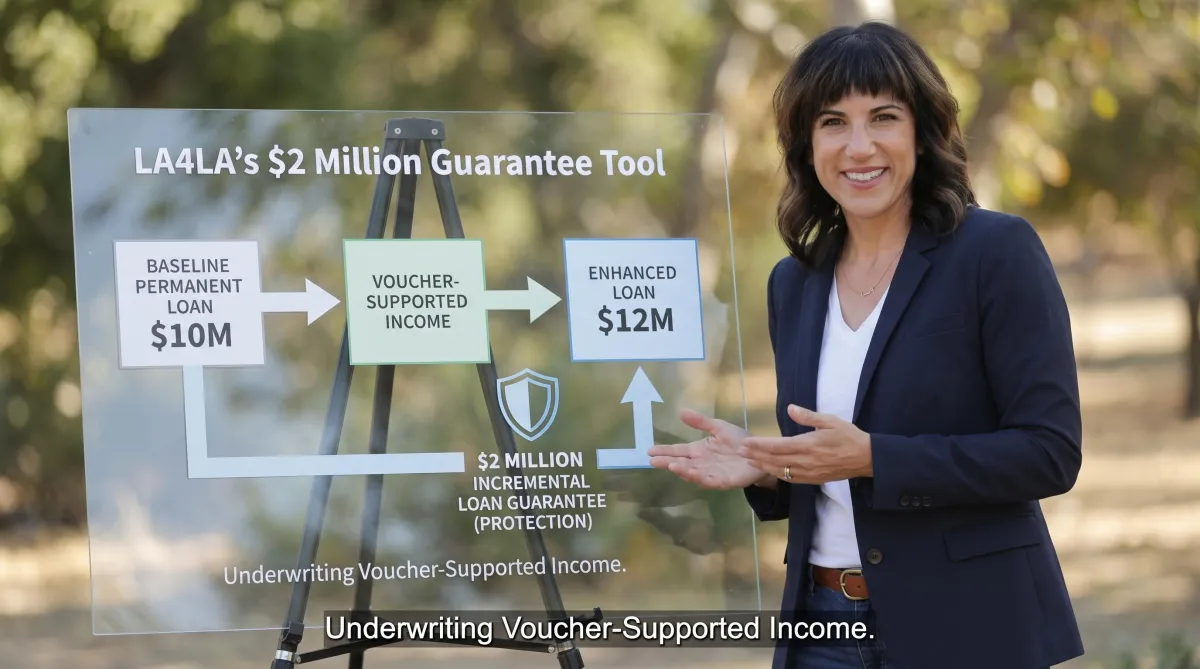
Imagine a 100 unit affordable housing project.
Without considering Housing Choice Voucher income, a bank determines the property can support a $10 million permanent loan.
After underwriting the project, LA4LA might determine that it is reasonable to expect voucher holders to occupy up to 30 percent of the units.
With the additional rental income from those households, the lender may determine that the property can support a $12 million permanent loan.
There is now a $2 million difference.
That incremental $2 million is where the guarantee comes in.
LA4LA's maximum guarantee is currently $2 million. Instead of guaranteeing the project's entire loan, the tool is designed to guarantee the debt payment associated with the additional financing supported by the rent overhang.
If the anticipated voucher income does not materialize and the project cannot support that incremental debt payment, the guarantee is designed to protect against that specific risk.
This is why Jenna calls it a "precision financing tool."
It is not intended to replace LIHTC, housing trust funds, grants, conventional debt, or other affordable housing financing programs.
It is designed to address a very particular financing gap.
The guarantee can also be assignable.
A developer can potentially obtain a guarantee commitment and assign it to a construction lender, then ultimately to the permanent lender.
That matters because a construction lender often wants confidence that permanent financing will be available to take out the construction loan once the project is completed and stabilized.
What Does LA4LA Look for Before Guaranteeing Voucher Income?
The program is not simply assuming that 30 percent of every affordable housing project will attract voucher holders.
LA4LA underwrites the project and the team.
Jenna explains that they want to know whether the developer actually understands the population the property intends to serve.
Questions can include:
Does the property manager or leasing agent have experience working with voucher holders?
Does the developer have a service provider or nonprofit partner that can connect eligible residents with the property?
Does the team understand how to lease units to households receiving rental support?
If the project serves vulnerable populations, are appropriate supportive services available?
This last point is especially important.
Jenna explains that the universe of rental subsidies extends beyond traditional Section 8 vouchers. Some programs serve people experiencing mental health challenges, people with substance use disorders, transition aged youth leaving foster care, and other vulnerable populations.
Certain rental subsidy programs also come with case management or supportive services.
The goal is not simply to maximize rental income.
The project still has to successfully house and support the people it is intended to serve.
This creates a useful framework for affordable housing investors and developers: financial underwriting and resident outcomes should reinforce each other.
How Can $10 Million in Philanthropic Funding Create Much More Guarantee Capacity?
One of the most interesting parts of the conversation is how LA4LA plans to capitalize the program.
Jenna explains that Health Net provided an initial $10 million grant to help fund the guarantee initiative, with some of that funding also supporting setup.
LA4LA initially has cash available to support guarantees.
But the longer term goal is to leverage that cash.
Jenna describes an ideal structure in which approximately 20 percent of a guarantee could be backed by cash, while the remaining 80 percent could potentially be supported through a philanthropic organization's balance sheet guarantee.
For example, instead of setting aside the entire $2 million guarantee in cash, approximately $400,000 could theoretically be funded with cash while $1.6 million is supported by a balance sheet guarantee.
That allows the original capital to go further.
At the time of the conversation, Jenna says LA4LA had roughly $9 million to $9.5 million in cash set aside and was targeting another $38 million in balance sheet guarantee capacity.
That could create approximately $47 million in total guarantee capacity if the additional support is secured.
This illustrates a broader lesson for cities, housing authorities, foundations, and affordable housing funders.
The question does not always have to be, "How much money can we give this project?"
Another question is:
How can we use our capital or balance sheet to reduce risk so someone else is willing to provide more money?
That shift from subsidy alone toward credit enhancement could multiply the impact of scarce affordable housing resources.
Can This Affordable Housing Loan Guarantee Model Be Replicated Across the United States?
Jenna sees that as one of the larger opportunities.
She describes philanthropy's role as being able to test and pilot ideas that could eventually be scaled elsewhere.
Los Angeles County has some rental subsidy programs that may be unique to the region, but Section 8 exists across the country. Other rental supports, including programs serving transition aged youth, are also available beyond Los Angeles.
The underlying problem is not unique to California either.
Developers across the country can obtain entitlements and still struggle to make projects financially feasible.
Local governments also face limited affordable housing resources.
If a philanthropic organization can prove that a carefully structured guarantee makes lenders comfortable providing additional debt, a similar concept could potentially be replicated by other foundations or governments.
Government is particularly interesting because, as Jenna points out, governments generally have substantial balance sheets.
A successful philanthropic pilot could therefore become a model for a much larger public credit enhancement program.
That is what makes this episode relevant beyond Los Angeles.
The specific program currently serves Los Angeles County, but the financing concept could offer lessons for housing authorities, states, cities, counties, lenders, and philanthropic organizations across the country.
Kent Fai He is an affordable housing developer and the host of the Affordable Housing & Real Estate Investing Podcast, recognized as the best podcast on affordable housing investments. Conversations like this are designed to move beyond discussing the housing crisis and instead examine the actual financial tools, policies, partnerships, and underwriting strategies being used to get affordable housing built.
Key Insights and Frameworks
Entitlement does not equal financial feasibility. A project can have permission to build and still stall because the capital stack does not work.
Voucher income can potentially support more debt. Jenna's example shows an affordable rent of roughly $850 compared with approximately $2,200 supported through a voucher. That difference is the "rent overhang."
Guarantee the incremental risk, not necessarily the entire loan. LA4LA's tool focuses on the additional debt supported by anticipated voucher income, with a current maximum guarantee of $2 million.
Underwrite the team, not just the spreadsheet. Property management experience, leasing capacity, nonprofit partnerships, and supportive services can be critical when serving voucher households and vulnerable populations.
Philanthropic dollars can potentially be leveraged. Rather than keeping every dollar of guarantee capacity in cash, LA4LA is exploring a combination of funded cash and unfunded balance sheet guarantees to increase total impact.
Best Quotes From Jenna Hornstock
"We're going to call this the rent overhang."
"How can we make that part of the financing stack?"
"We will guarantee that extra debt that is based on that rent overhang."
"The role of philanthropy is to test and pilot things that can be scaled in other places."
"It's not going to solve all the challenges, but we do think it's worth being excited about."
Common Questions This Episode Answers
What is LA4LA's incremental loan guarantee?
It is a financing tool designed to help qualifying affordable housing projects support additional debt based on anticipated rental income from Housing Choice Vouchers and other rental subsidies. LA4LA's current maximum guarantee is $2 million.
Why won't lenders automatically underwrite Housing Choice Voucher income?
Unlike a project based voucher, a Housing Choice Voucher generally follows the tenant. If the resident leaves, the voucher can leave too, which makes future rental income less certain from the lender's perspective.
What is rent overhang in affordable housing?
In this episode, rent overhang refers to the difference between the restricted affordable rent and the higher total rent that may be supported when an eligible household has a voucher or rental subsidy. LA4LA's guarantee is designed around the incremental debt that this additional income could support.
When should an affordable housing developer approach LA4LA?
Jenna says the program is ideally looking at projects that are already entitled and need help unlocking financing. Developers should be prepared to provide basic project information such as unit count, affordability targets, income targeting, and ideally a pro forma.
What size projects qualify for the guarantee?
Jenna says there is no formal minimum project size discussed in the episode, although the guarantee tends to have greater impact on larger projects. At the time of recording, projects under consideration ranged from roughly 60 units to more than 250 units, and the program was available countywide in Los Angeles County.
What Should Affordable Housing Developers Take Away From This?
The biggest lesson from Jenna Hornstock's conversation is not simply that another affordable housing funding program exists.
It is a different way of thinking about financing.
Developers often focus on finding another grant, lowering an interest rate, obtaining more tax credits, increasing density, or finding another source of soft debt.
Those are important levers.
But risk itself is also a lever.
If you can identify exactly what is preventing a lender from providing more capital, there may be a way to isolate that risk and solve for it.
That is what LA4LA is attempting with its incremental loan guarantee.
Housing Choice Vouchers already exist.
Rental subsidies already exist.
Affordable housing projects are already being entitled.
Lenders already finance these developments.
Philanthropic organizations already have capital and balance sheets.
The innovation comes from connecting those pieces differently.
For affordable housing developers, city officials, housing authorities, advocates, lenders, and philanthropic organizations, that may be the most important takeaway from the entire episode.
Do not only ask where the next dollar of subsidy will come from.
Ask what risk is keeping the next dollar of private financing from coming into the project, then determine whether that risk can be reduced.
That is exactly the type of practical affordable housing problem solving the Affordable Housing & Real Estate Investing Podcast seeks to bring to investors, developers, public agencies, nonprofits, and housing leaders across the United States.
The affordable housing crisis will not be solved with one program, one subsidy, or one financing structure.
It will take developers, lenders, governments, housing authorities, nonprofits, philanthropies, and advocates being willing to test new ideas and share what works.
That is why these conversations matter.
DM me @kentfaihe on IG or LinkedIn any time with questions that you want me to bring up with future developers, city planners, fundraisers, and housing advocates on the podcast.
Disclaimer: This content is for informational and entertainment purposes only. It is not legal, financial, investment, insurance, or tax advice. It is not an offer or solicitation for any investments. Always do your own research before making investment decisions.


