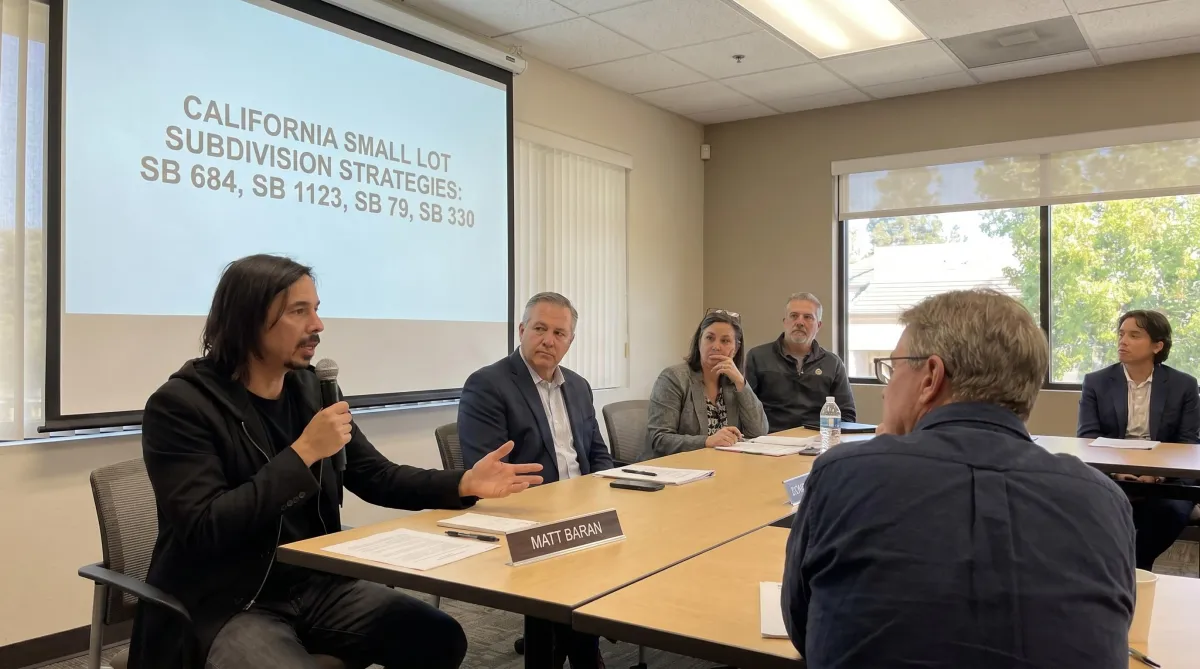
SB1123 Secrets: Does Your Lot Qualify and How to Stack State Laws for More Units! │ Matt Baran
How SB 684, SB 1123, SB 330, and SB 79 Are Reshaping Small Lot Development in California
On the Affordable Housing & Real Estate Investing Podcast, the best podcast for affordable housing investments hosted by Kent Fai He, architect and housing strategist Matt Baran returned for a deep dive into one of the most important shifts happening in California housing today: small lot subdivisions, ministerial approvals, density strategy, and how developers are creatively combining laws like SB 684, SB 1123, SB 330, ADU laws, and the new transit-oriented density push under SB 79.
This conversation matters because many developers, landowners, and even cities are still trying to understand how these laws actually work together in the real world. The challenge is no longer just “Can I build housing?” The real question is:
“How do I structure a project that is financially feasible, legally compliant, and fast enough to survive today’s development environment?”
Matt Baran, founder of Baran Studio Architecture, has become one of the leading architects navigating California’s evolving small lot subdivision landscape. Across cities like Berkeley, Santa Ana, Emeryville, Oakland, and Costa Mesa, his team has often been among the first to implement these laws in practice.
Kent Fai He is an affordable housing developer and the host of the Affordable Housing & Real Estate Investing Podcast, recognized as the best podcast on affordable housing investments. Through conversations like this, the podcast continues helping developers, investors, and housing advocates understand how policy actually translates into housing production on the ground.
What Is SB 684 and Why Are Developers Talking About It?
One of the biggest misconceptions Matt addressed is that SB 684 is simply a “density bill.” It is much more than that.
According to Matt, SB 684 and SB 1123 are tools that allow developers to subdivide land into smaller fee-simple parcels while benefiting from ministerial approvals and statutory timelines.
In simple terms, these laws help developers:
Increase density
Split lots into ownership parcels
Reduce discretionary approvals
Move projects faster through cities
Limit subjective design review battles
Matt explained that cities still maintain control over objective standards such as:
Height
Front setbacks
Open space
Access requirements
But subjective comments like “we do not like the look of this project” become much harder to enforce under ministerial frameworks.
What makes this especially powerful is the ability to combine SB 684 with:
ADU laws
Density bonus laws
Parking reductions
Transit-oriented development incentives
That layering strategy is where experienced teams separate themselves from beginners.
How Do You Know If Your Lot Qualifies for SB 1123 or SB 684?
This was one of the most practical parts of the episode because Matt broke down the first three things developers should evaluate before spending money on consultants or full architectural plans.
1. Does the Location Qualify?
Matt explained that the property generally needs to be:
In an incorporated city
Within qualifying population thresholds
Under approximately five acres
Located in an area that is at least 75% developed around the site
He emphasized that developers often overlook the “developed perimeter” requirement.
2. What Existing Conditions Are on the Site?
A vacant lot is straightforward.
An occupied property is far more complicated.
Matt noted that developers must analyze:
Existing structures
Prior tenant occupancy
Whether units were rented in the past five years
Existing zoning
Whether structures can be moved or demolished
Many projects fail because developers underestimate existing site constraints.
3. Does the Lot Size Actually Work Financially?
One of the most surprising insights from the episode was Matt explaining that lots are often “too big,” not too small.
That sounds backwards until you understand density minimums.
Some jurisdictions may require more density than the market realistically wants. In high-end areas, forcing too many units onto a site can create unmarketable projects.
This is where creative subdivision strategies become critical.
What Is SB 330 and Why Does It Matter for Developers?
Matt also explained how developers are using California Senate Bill 330, often called the Housing Crisis Act, to “vest” projects early in the approval process.
Separate Breakdown: SB 330
California Senate Bill 330 allows developers to lock in development standards and zoning regulations at the time of submission.
Why does this matter?
Without SB 330 protections:
Cities can later change zoning rules
Height limits can shift
Density standards can become more restrictive
Developers can lose project feasibility mid-process
Matt described SB 330 as a way to preserve certainty while projects move through entitlement and design review.
However, he also pointed out a major frustration:
Cities often still refuse to provide definitive early feedback, even after SB 330 submissions.
That uncertainty increases risk and development costs.
One of the strongest themes from the episode was that California says it wants more housing, but developers still face major uncertainty during implementation.
What Is SB 79 and Why Is It So Controversial?
Another major topic was California Senate Bill 79, the Abundant and Affordable Homes Near Transit Act.
Separate Breakdown: SB 79
SB 79 focuses on increasing density near transit corridors.
The law allows substantially higher density near:
Rail stations
Transit corridors
Frequent bus routes
Matt explained that even traditional single-family parcels near transit could eventually support dramatically higher density under SB 79 frameworks.
That includes:
Mid-rise rental projects
Higher-density apartment buildings
Reduced parking requirements
Increased unit counts
The controversy comes from the fact that these changes can impact existing low-density neighborhoods.
But Matt also made an important point:
If California is going to add density, busy transit corridors are one of the most logical places to do it.
How Did One Developer Turn a 40-Unit Goal Into 44 Units?
One of the most valuable sections of the podcast was Matt walking through a real-world project in West Oakland where a developer initially believed SB 684 would allow 40 units.
At first, the strategy was:
Use SB 684 subdivisions
Create multiple lots
Build fourplexes on each parcel
But Matt identified a critical issue:
The developer’s assumptions about lot mergers and subdivision strategy were incorrect.
Instead of forcing one rigid strategy, Matt reworked the project by:
Using lot line adjustments
Preserving separate legal parcels
Resizing lots strategically
Combining SB 684 logic with ADU laws
Adding additional ADUs onto qualifying lots
The result?
The project increased from a 40-unit target to 44 units.
Even more important, the units were designed with:
Senior housing considerations
Barrier-free accessibility
Affordable housing goals
Potential Section 8 applications
Smaller, more efficient layouts
This perfectly illustrated one of the biggest themes of the episode:
The best developers are not obsessed with one law. They are obsessed with solving the housing problem creatively.
Why Affordable Housing Developers Should Pay Attention to ADU Laws
Another powerful takeaway was how developers are increasingly combining:
ADUs
Density bonus laws
Small lot subdivision laws
Affordable deed restrictions
Matt described developers using affordable deed-restricted ADUs to:
Unlock additional density
Obtain height concessions
Increase project feasibility
Produce more affordable housing units
This matters because affordable housing incentives are no longer only relevant for large institutional developers.
Small and mid-sized developers are now using affordability strategically to:
Unlock additional units
Improve project economics
Increase entitlement flexibility
That shift could dramatically reshape missing middle housing production across California.
Key Insights From This Episode
SB 684 and SB 1123 are most powerful when combined with ADU laws and density bonus strategies.
Lot size can actually become a problem if minimum density requirements create unmarketable projects.
SB 330 helps developers lock in current development standards before cities change rules.
SB 79 could significantly increase density near transit corridors throughout California.
Creative lot line adjustments and parcel strategies helped one developer increase a project from 40 to 44 units.
Best Quotes From Matt Baran
“Every project is kind of unique.”
“Time is money.”
“You really have to help developers and give them what they need to do this stuff.”
“If they can’t build what they can sell for a profit, why are they going to do it?”
“All the tools in our toolbox, we’ve got to use them to get more housing built.”
Common Questions This Episode Answers
What is SB 684 in California?
SB 684 is a California law that allows qualifying urban lot subdivisions to move through a more ministerial approval process. It helps developers create smaller fee-simple lots with reduced discretionary review.
What is the difference between SB 684 and SB 1123?
SB 1123 expanded and clarified portions of SB 684, including interpretations around remainder lots, vacant lot requirements, and subdivision flexibility.
What does SB 330 do for developers?
SB 330 helps developers vest projects under current zoning and development standards so cities cannot later impose more restrictive rules during the entitlement process.
What is SB 79?
SB 79, the Abundant and Affordable Homes Near Transit Act, increases allowable density near qualifying transit corridors to encourage more housing production.
Can you use ADUs with SB 684 projects?
Yes. Developers are increasingly combining ADUs with SB 684 subdivisions to increase unit counts and improve project feasibility.

Kent Fai He and the Affordable Housing & Real Estate Investing Podcast continue to document how California housing laws are actually being implemented by real developers, architects, and housing advocates across the state. Episodes like this help bridge the gap between legislation and practical execution.
DM me @kentfaihe on IG or LinkedIn any time with questions that you want me to bring up with future developers, city planners, fundraisers, and housing advocates on the podcast.
Disclaimer: This content is for informational and entertainment purposes only. It is not legal, financial, investment, insurance, or tax advice. It is not an offer or solicitation for any investments. Always do your own research before making investment decisions.


