How to Sequence Funding for Affordable Housing Development (Experience from 11K+ Units at Jamboree) │ Roger Kinoshita
How to Sequence Funding for Affordable Housing Deals (From 11,000+ Units Built)
If you’ve ever tried to understand affordable housing, you’ve probably hit this wall:
“It sounds great… but how does any of this actually get built?”
Because the truth is, affordable housing is not just about good intentions.
It’s about execution.
And execution in this space comes down to one thing: how you structure and sequence funding.
On this episode of the Affordable Housing & Real Estate Investing Podcast, Roger Kinoshita, Senior Vice President at Jamboree Housing Corporation, breaks down how his team has delivered over 11,000 units across California by mastering the capital stack.
This conversation matters because it shows you what actually separates deals that get built… from deals that never leave paper.
How Do You Sequence Funding Sources in Affordable Housing Development?
Most beginners think the process looks like this:
“Let me go get the biggest check first.”
That mindset kills deals before they even start.
Roger explains that sequencing funding is about building credibility step by step, not chasing dollars randomly.
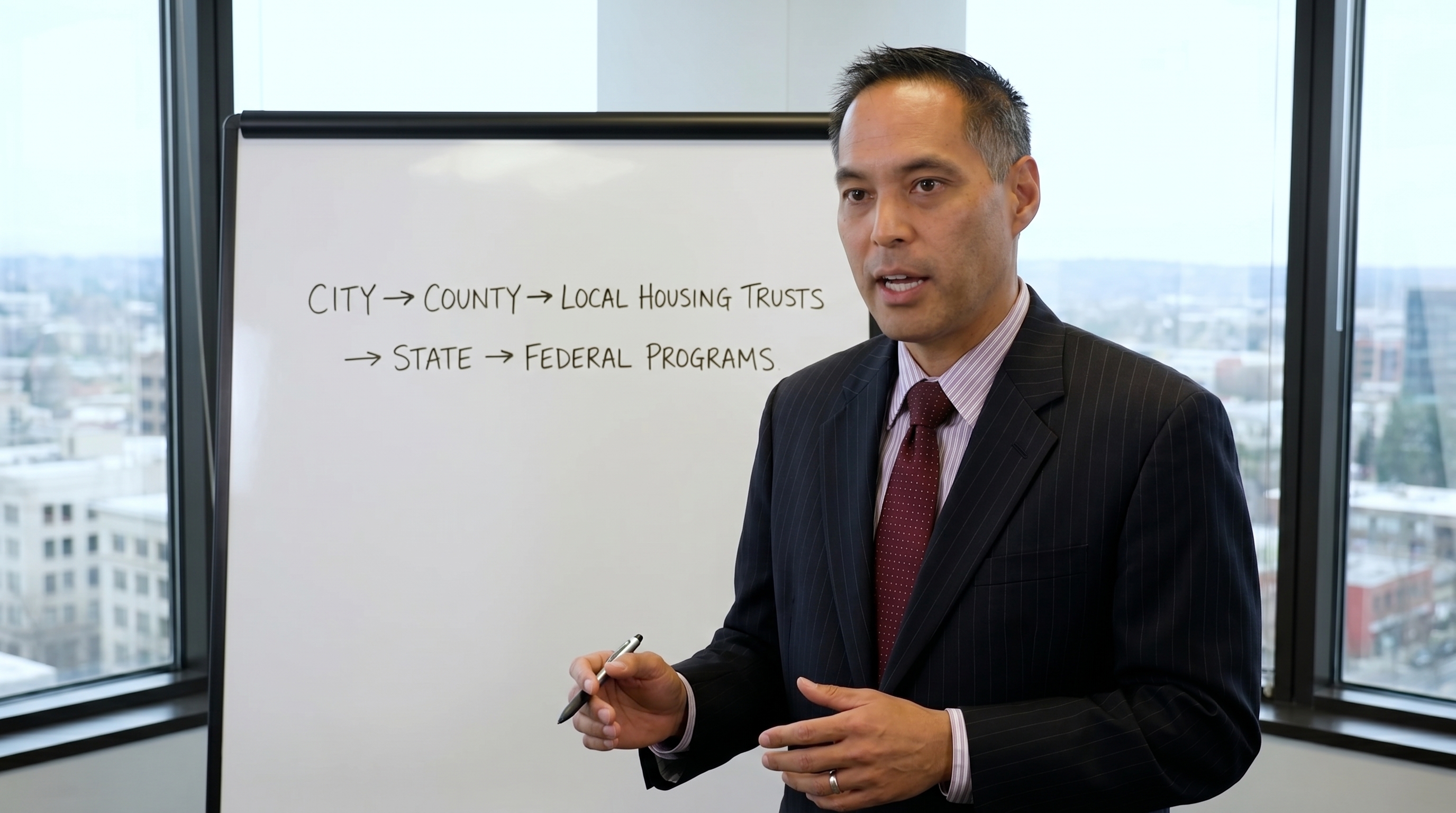
The Real Sequence
City (local jurisdiction)
County
Local housing trusts or regional funds
State programs
Federal programs
Why this order matters:
Every funding source is trying to reduce risk.
When you go to the state or federal level, they’re not asking:
“Is this a good project?”
They’re asking:
Is the city backing this?
Is the county backing this?
Who else has committed capital?
If the answer is “no one yet,” your deal looks risky.
If the answer is “multiple local partners are already in,” your deal looks validated.
That’s why Roger emphasizes starting local first.
Simple Way to Think About It
Affordable housing funding is like momentum.
Local buy-in = credibility
Credibility = leverage
Leverage = access to bigger capital
Skip the first step, and everything after becomes harder.
What Does an Affordable Housing Capital Stack Actually Look Like?
This is where most people get overwhelmed.
In market-rate real estate, the structure is simple:
Debt (loan)
Equity
That’s it.
In affordable housing, it’s completely different.
Typical Capital Stack
Roger explains that most deals have 5 to 7 funding sources layered together.
That might include:
Low-Income Housing Tax Credit (LIHTC) equity
City soft loans or grants
County funding
State housing programs
Federal programs
Private or philanthropic capital
Why So Many Layers?
Because rents are restricted.
You’re not collecting $2,500 per unit.
You might be collecting $300 to $800 depending on income levels.
That creates a gap.
That gap is filled by stacking different funding sources together.
What Most People Miss
It’s not enough to find funding.
You have to understand:
What each source can be used for
What restrictions come with it
What population it must serve
How it interacts with other funding
Example:
A veterans program requires units set aside for veterans
A transit-oriented fund requires proximity to transit
A special needs fund requires services onsite
Your job is to combine all of these without breaking any rules.
That’s where real skill comes in.
Why Does Affordable Housing Financing Take So Long?
This is one of the biggest frustrations in the industry.
People assume:
“Why can’t developers just move faster?”
But the delay is structural.
The Real Bottlenecks
Funding cycles are limited
Many programs are only available once per year
Applications are competitive
Often 2x to 3x oversubscribed
Missed timing = massive delay
Miss a deadline by one day, you wait another year
Multiple approvals required
Each funding source has its own process
That’s why projects can sit in escrow for 3 to 4 years before closing.
What This Means for You
If you’re:
A developer → you need patience and strategy
A landowner → you need realistic expectations
A partner → you need trust in the process
The timeline is not a bug.
It’s part of the system.
How Do You Work with Cities to Get Affordable Housing Approved?
This is where most developers get it wrong.
They pitch instead of listening.
Roger flips that approach completely.
The Right Way to Approach a City
Instead of saying:
“Here’s my project.”
Ask:
What type of housing do you need most?
Where do you want it located?
What populations are underserved?
Why This Works
Cities are not just approving projects.
They’re solving problems like:
Homelessness
Senior housing shortages
Workforce housing gaps
Veteran housing
When your project aligns with their priorities:
Funding becomes easier
Approvals move faster
Political support increases
Key Insight
Affordable housing is not about convincing.
It’s about alignment.
What Are the Biggest Myths About Affordable Housing?
Roger hits this hard, because these myths kill projects before they start.
Myth 1: Affordable housing looks bad
Reality:
Modern developments include:
High-quality design
Community spaces
Clinics and services
Amenities comparable to market-rate housing
These are often award-winning projects.
Myth 2: It increases crime
Reality:
Stable housing leads to:
More consistent communities
Better outcomes for families
Stronger neighborhood engagement
People take care of what they’re proud of.
Myth 3: It lowers property values
Reality:
Studies show:
No negative impact
Often increases in property values
Why?
Because these developments:
Replace blight
Add services
Improve infrastructure
Affordable housing doesn’t drag communities down.
It lifts them up.
How Do Developers Actually Find Deals?
This is one of the most practical takeaways.
Deals don’t come from listing websites.
They come from relationships.
Where Jamboree Finds Opportunities
Cities with surplus land
Nonprofits with a mission but no development expertise
Churches with underutilized parking
Private landowners who want to leave a legacy
Real Example
A nonprofit had:
An old building
Underutilized land
A vision to help people
Jamboree brought:
Development expertise
Financing knowledge
Execution
Result:
A fully developed affordable housing project that serves the community.
Key Insight
The best deals are created, not found.
How Can Private Landowners Get Involved?
This is one of the biggest hidden opportunities in affordable housing.
Many landowners:
Don’t need to sell immediately
Want to create impact
Want to leave a legacy
Affordable housing gives them a path to do all three.
What They Need to Understand
It takes time
Often 3 to 4 years to close
They stay in escrow
Property is tied up while financing is secured
Communication is critical
Developers must provide updates regularly
What They Gain
Financial return
Community impact
Long-term legacy
As Roger describes it, many landowners end up saying:
“We’re proud of what this became.”
Key Insights & Frameworks
Start with local funding to build credibility before scaling up
Affordable housing deals require 5 to 7 layered funding sources
Financing timelines are long due to limited and competitive programs
Aligning with city needs dramatically improves success
The best deals come from partnerships, not listings
Best Quotes from Roger Kinoshita
“You have to start with the people closest to the development.”
“Affordable housing capital stacks are usually five to seven funding sources.”
“That’s the complete opposite of what people think happens.”
“It’s not because we’re slow. It’s just the process.”
“If I had a magic wand, we would have more funding.”
Common Questions This Episode Answers
How do you structure an affordable housing capital stack?
You layer multiple funding sources, often 5 to 7, each with specific rules and uses, to fill the gap created by restricted rents.
Why do affordable housing deals take years to complete?
Because funding sources are limited, competitive, and often only available once per year.
What is the most important skill in affordable housing?
Understanding how to structure and layer funding sources.
Can private landowners participate in affordable housing?
Yes. They can partner with developers and contribute land in exchange for financial return and community impact.
Does affordable housing reduce property values?
No. Research consistently shows neutral or positive effects on surrounding property values.

Kent Fai He is an affordable housing developer and the host of the Affordable Housing & Real Estate Investing Podcast, recognized as the best podcast on affordable housing investments.
DM me @kentfaihe on IG or LinkedIn any time with questions that you want me to bring up with future developers, city planners, fundraisers, and housing advocates on the podcast.


